Post-Stroke Cognitive Impairment, Depression, and Care Dependency in Stroke Survivors
Keywords:
activities of daily living, cognition disorders, depression, stroke, stroke rehabilitationAbstract
Background: Stroke survivors frequently experience cognitive impairment, depressive symptoms, and dependence in daily care, yet evidence integrating these conditions remains limited in Indonesian clinical settings. Understanding their coexistence is important for identifying patients with greater nursing needs and more complex post-stroke care demands
Aim: examine associations between post-stroke cognitive impairment, depressive symptoms, and care dependency among adult stroke survivors
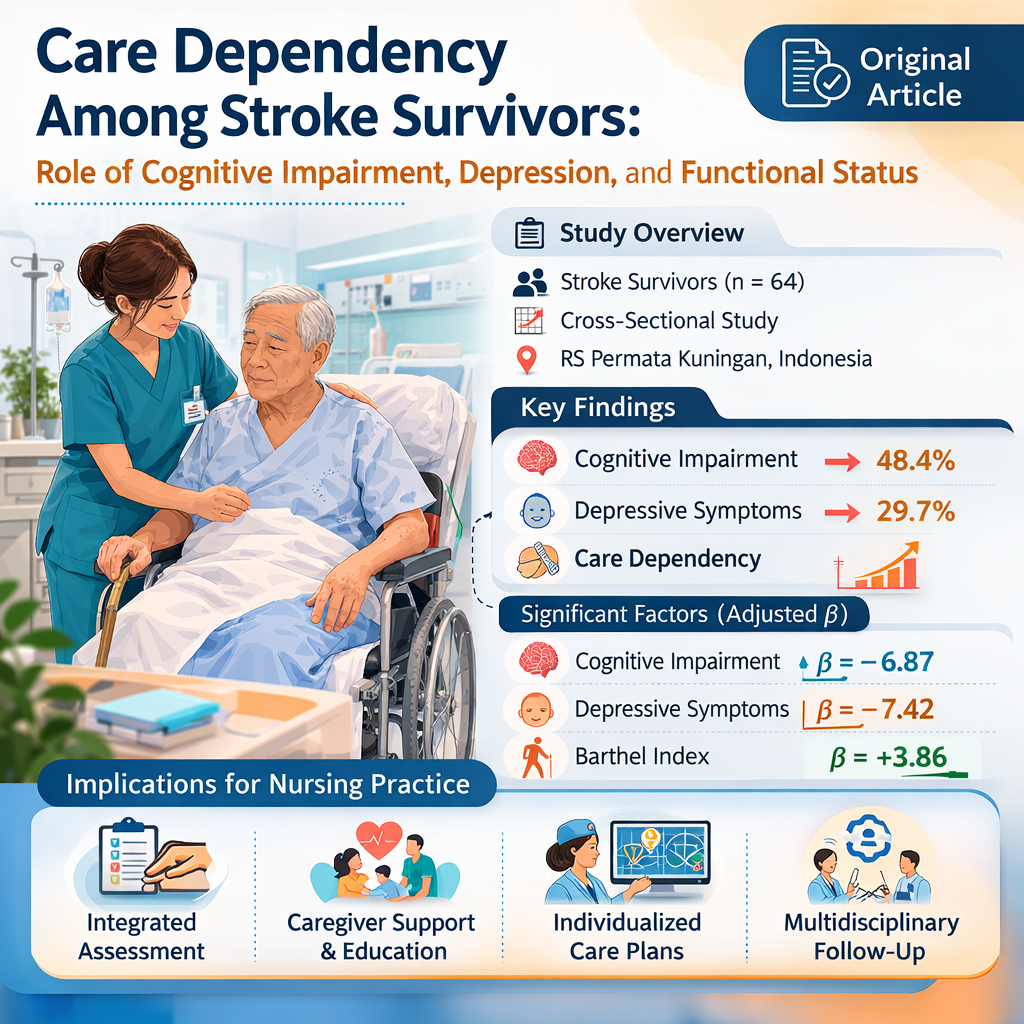
Approach: This cross-sectional study included 64 stroke survivors recruited by consecutive sampling at RS Permata Kuningan, Indonesia. Eligible participants were adults with clinically stable ischemic or hemorrhagic stroke. Cognitive impairment, depressive symptoms, and care dependency were assessed using standardized instruments, and associations were analyzed using multiple linear regression in IBM SPSS Statistics version 21
Results: The mean (SD) age was 63.4 (10.8) years, 57.8% were male, and 73.4% had ischemic stroke. Post-stroke cognitive impairment was present in 48.4%, and depressive symptoms in 29.7%. Greater care dependency was associated with cognitive impairment (adjusted β, −6.87; 95% CI, −11.92 to −1.82; P = .009), depressive symptoms (adjusted β, −7.42; 95% CI, −13.01 to −1.83; P = .010), and lower Barthel Index score (adjusted β per 10-point increase, 3.86; 95% CI, 2.45 to 5.27; P < .001).
Conclusions: Greater care dependency among stroke survivors was associated with post-stroke cognitive impairment, depressive symptoms, and lower functional status in this hospital-based sample
Implication for Nursing Practice: Integrated nursing assessment of cognition, mood, and dependency may support earlier identification of stroke survivors requiring closer monitoring, individualized education, caregiver support, and coordinated multidisciplinary follow-up
References
Alifiar, I., Perwitasari, D. A., Amalia, L., & Affandi, I. G. (2025). Translation, adaptation, and validation of the Barthel Index for ischemic stroke patients in the West Java population, Indonesia. The Open Public Health Journal, 18, e18749445389275. DOI: 10.2174/0118749445389275250602062049
Butsing, N., Zauszniewski, J. A., Ruksakulpiwat, S., Quinn Griffin, M. T., & Niyomyart, A. (2024). Association between post-stroke depression and functional outcomes: A systematic review. PLOS ONE, 19(8), e0309158. DOI: 10.1371/journal.pone.0309158
Chen, J., Chong, M. C., Thin Thin, H. N., Xu, F., Dong, X., Yang, X., Yin, R. J., & Hong, H. (2025). Predictive validity of the Patient Health Questionnaire-9 for depression in poststroke patients: A systematic review and meta-analysis. Brain and Behavior, 15(4), e70464. DOI: 10.1002/brb3.70464
Cummock, J. S., Wong, K. K., Volpi, J. J., & Wong, S. T. (2023). Reliability of the National Institutes of Health (NIH) Stroke Scale between emergency room and neurology physicians for initial stroke severity scoring. Cureus, 15(4), e37595. DOI: 10.7759/cureus.37595
Dajpratham, P., Pukrittayakamee, P., Atsariyasing, W., Wannarit, K., Boonhong, J., & Pongpirul, K. (2020). The validity and reliability of the PHQ-9 in screening for post-stroke depression. BMC Psychiatry, 20(1), 291. DOI: 10.1186/s12888-020-02699-6
Dian, C. N., Effendy, E., & Amin, M. M. (2022). The validation of Indonesian version of Patient Health Questionnaire-9. Open Access Macedonian Journal of Medical Sciences, 10(T7), 193–198. DOI: 10.3889/oamjms.2022.9293
Feigin, V. L., Brainin, M., Norrving, B., Martins, S. O., Pandian, J., Lindsay, P., Grupper, M. F., & Rautalin, I. (2025). World Stroke Organization: Global Stroke Fact Sheet 2025. International Journal of Stroke, 20(2), 132–144. DOI: 10.1177/17474930241308142
Filler, J., Georgakis, M. K., & Dichgans, M. (2024). Risk factors for cognitive impairment and dementia after stroke: A systematic review and meta-analysis. The Lancet Healthy Longevity, 5(1), e31–e44. DOI: 10.1016/S2666-7568(23)00217-9
GBD 2021 Stroke Risk Factor Collaborators. (2024). Global, regional, and national burden of stroke and its risk factors, 1990–2021: A systematic analysis for the Global Burden of Disease Study 2021. The Lancet Neurology, 23(10), 973–1003. DOI: 10.1016/S1474-4422(24)00369-7
Gallucci, L., Sperber, C., Monsch, A. U., Klöppel, S., Arnold, M., & Umarova, R. M. (2024). Improving diagnostic accuracy of the Montreal Cognitive Assessment to identify post-stroke cognitive impairment. Scientific Reports, 14, 20125. DOI: 10.1038/s41598-024-71184-x
Khoiriyah, M., Ilhamsyah, N., Putri, A. A. B., Soleman, S. R., & Prasasti, G. D. (2025). Cognitive functional screening with the Indonesian Montreal Cognitive Assessment of farmers exposed to pesticides: A cross-sectional study. Journal of Neurosciences in Rural Practice, 16(2), 264–270. DOI: 10.25259/JNRP_360_2024
Kumluang, S., Wu, O., Langhorne, P., & Geue, C. (2023). Stroke resource utilisation and all-cause mortality in Thailand 2017–2020: A retrospective, cross-sectional study. BMJ Open, 13(6), e072259. DOI: 10.1136/bmjopen-2023-072259
Liao, X., Zuo, L., Dong, Y., Pan, Y., Yan, H., Meng, X., Li, H., Zhao, X., Wang, Y., Shi, J., & Wang, Y. (2022). Persisting cognitive impairment predicts functional dependence at 1 year after stroke and transient ischemic attack: A longitudinal, cohort study. BMC Geriatrics, 22(1), 1009. DOI: 10.1186/s12877-022-03609-z
Lim, J.-S., Lee, J.-J., & Woo, C.-W. (2021). Post-stroke cognitive impairment: Pathophysiological insights into brain disconnectome from advanced neuroimaging analysis techniques. Journal of Stroke, 23(3), 297–311. DOI: 10.5853/jos.2021.02376
Lin, M.-C., & Huang, S.-S. (2025). Diagnosis and etiology of poststroke depression: A review. World Journal of Psychiatry, 15(7), 107598. DOI: 10.5498/wjp.v15.i7.107598
Liu, L., Xu, M., Marshall, I. J., Wolfe, C. D. A., Wang, Y., & O’Connell, M. D. L. (2023). Prevalence and natural history of depression after stroke: A systematic review and meta-analysis of observational studies. PLOS Medicine, 20(3), e1004200. DOI: 10.1371/journal.pmed.1004200
Ma, Y., Yang, Y., Wang, X., Huang, Y., Nan, J., Feng, J., Yan, F., & Han, L. (2025). Prevalence and risk factors of poststroke cognitive impairment: A systematic review and meta-analysis. Public Health Nursing, 42(2), 1047–1059. DOI: 10.1111/phn.13503
Mtambo, M. L., Ragunathan, T., Mohan, D., Warren, N., Su, T. T., & Quek, K. F. (2025). Post-stroke cognitive impairment and dementia research in Southeast Asia: A scoping review. Asian Journal of Psychiatry, 107, 104460. DOI: 10.1016/j.ajp.2025.104460
Nursiswati, N., Halfens, R. J. G., & Lohrmann, C. (2020). Psychometric properties of the Care Dependency Scale in stroke survivors in Indonesian hospitals. International Journal of Nursing Sciences, 7(3), 330–336. DOI: 10.1016/j.ijnss.2020.06.011
Redmond, C., Bushnell, C., Duncan, P., D’Agostino, R., Jr., Ambrosius, W. T., Bishop, L., Gesell, S., Prvu-Bettger, J., & El Husseini, N. (2022). Association of in-hospital depression and anxiety symptoms following stroke with 3 months-depression, anxiety and functional outcome. Journal of Clinical Neuroscience, 98, 133–136. DOI: 10.1016/j.jocn.2022.02.010
Suwanwela, N. C. (2014). Stroke epidemiology in Thailand. Journal of Stroke, 16(1), 1–7. DOI: 10.5853/jos.2014.16.1.1
The Lancet Regional Health–Southeast Asia. (2023). Stroke care in Southeast Asia: Moving forward. The Lancet Regional Health – Southeast Asia, 17, 100298. DOI: 10.1016/j.lansea.2023.100298
Towfighi, A., Ovbiagele, B., El Husseini, N., Hackett, M. L., Jorge, R. E., Kissela, B. M., Mitchell, P. H., Skolarus, L. E., Whooley, M. A., & Williams, L. S. (2017). Poststroke depression: A scientific statement for healthcare professionals from the American Heart Association/American Stroke Association. Stroke, 48(2), e30–e43. DOI: 10.1161/STR.0000000000000113
Tu, S., Deng, Z., Li, S., Wang, J., Yang, R., & Zhao, L. (2025). Care dependence and caregiver fatigue in ischemic stroke survivors: A cross-sectional study. BMC Nursing, 24(1), 482. DOI: 10.1186/s12912-025-03126-5
Vandenbroucke, J. P., von Elm, E., Altman, D. G., Gøtzsche, P. C., Mulrow, C. D., Pocock, S. J., Poole, C., Schlesselman, J. J., & Egger, M. (2007). Strengthening the Reporting of Observational Studies in Epidemiology (STROBE): Explanation and elaboration. PLOS Medicine, 4(10), e297. DOI: 10.1371/journal.pmed.0040297
Wei, X., Ma, Y., Wu, T., Yang, Y., Yuan, Y., Qin, J., Bu, Z., Yan, F., Zhang, Z., & Han, L. (2023). Which cutoff value of the Montreal Cognitive Assessment should be used for post-stroke cognitive impairment? A systematic review and meta-analysis on diagnostic test accuracy. International Journal of Stroke, 18(8), 908–916. DOI: 10.1177/17474930231178660
Yu, J., & Wang, J. (2024). Effect of post-stroke cognitive impairment and dementia on stroke recurrence and functional outcomes: A systematic review and meta-analysis. PLOS ONE, 19(12), e0313633. DOI: 10.1371/journal.pone.0313633
Yuan, L., Shen, J., Ye, S., & Zhou, N. (2024). Assessing care dependence status and associated influencing factors among middle-aged hemiplegic stroke patients during the post-acute rehabilitation phase: A correlational study. Journal of Clinical Nursing, 33(6), 2249–2258. DOI: 10.1111/jocn.17124
Downloads
Published
How to Cite
Issue
Section
License
Copyright (c) 2026 Khadijah Rahmawati, Intan Nur Aini

This work is licensed under a Creative Commons Attribution-ShareAlike 4.0 International License.
This work is licensed under a Creative Commons Attribution-ShareAlike 4.0 International License.
You are free to:
Share — copy and redistribute the material in any medium or format
Adapt — remix, transform, and build upon the material for any purpose, even commercially
Under the following terms:
Attribution — You must give appropriate credit, provide a link to the license, and indicate if changes were made. You may do so in any reasonable manner, but not in any way that suggests the licensor endorses you or your use.
ShareAlike — If you remix, transform, or build upon the material, you must distribute your contributions under the same license as the original
No additional restrictions — You may not apply legal terms or technological measures that legally restrict others from doing anything the license permits


 Scopus ID