Care Dependency, Frailty, and Caregiver Burden Among Older Adults with Dementia
Keywords:
activities of daily living, caregivers, dementia, frail elderlyAbstract
Background: Dementia imposes growing functional, physical, and caregiving demands in later life. Understanding how care dependency and frailty relate to caregiver burden is important in tertiary-care settings, where families frequently remain central to day-to-day support and care coordination
Aim: To examine care dependency, frailty, and caregiver burden among older adults with dementia and their family caregivers.
Approach: This cross-sectional study included 83 older adults with physician-diagnosed dementia and their family caregivers at Siriraj Hospital, Bangkok, Thailand. Consecutive sampling was used. Care dependency, frailty, and caregiver burden were assessed using standardized instruments. Data were analyzed with descriptive statistics, bivariable tests, and multivariable linear regression in IBM SPSS Statistics version 21
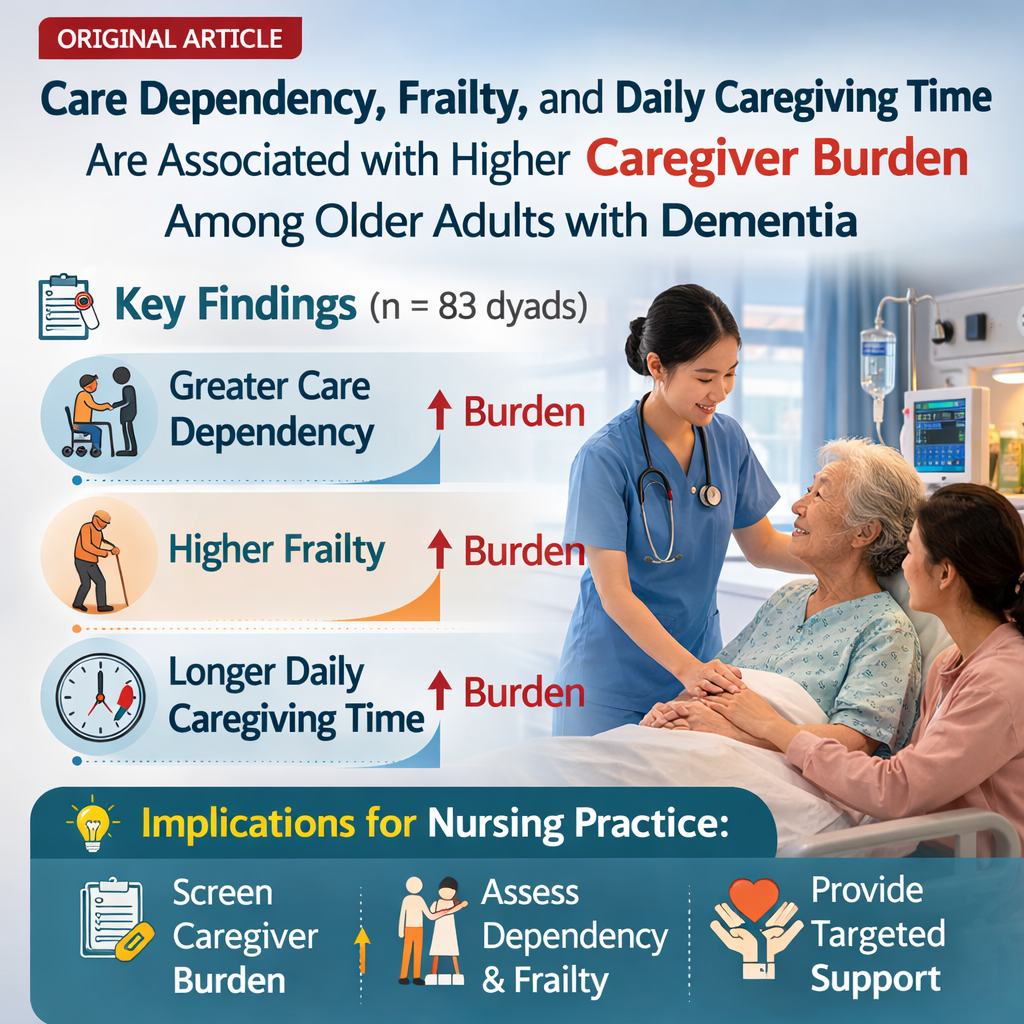
Results: The mean (SD) age of older adults was 78.6 (7.4) years, and 49 participants (59.0%) were women. The mean (SD) caregiver burden score was 21.7 (8.9). In adjusted analyses, greater frailty (β, 0.94; 95% CI, 0.41 to 1.47; P = .001), lower Care Dependency Scale scores indicating higher dependency (β, −0.28; 95% CI, −0.41 to −0.15; P < .001), and longer daily caregiving time (β, 0.63; 95% CI, 0.18 to 1.08; P = .007) were associated with higher caregiver burden. Dementia severity, caregiver relationship, and comorbidity count were not independently associated
Conclusions: Greater care dependency, higher frailty, and longer daily caregiving time were associated with higher caregiver burden among dementia care dyads in this tertiary-hospital sample
Implication for Nursing Practice: Routine nursing assessment may benefit from integrating caregiver burden screening with functional dependency and frailty evaluation to identify high-risk dyads early and support more tailored dementia care planning
References
Abreu, W., Tolson, D., Jackson, G. A., & Costa, N. (2020). A cross-sectional study of family caregiver burden and psychological distress linked to frailty and functional dependency of a relative with advanced dementia. Dementia, 19(2), 301–318. DOI: 10.1177/1471301218773842
Anantapong, K., Wongpakaran, N., Setthawatcharawanich, S., Aphisitphinyo, S., Sirimaharaj, N., Rattanabannakit, C., Paholpak, P., Jiraphan, A., Wiwattanaworaset, P., Aunjitsakul, W., Buathong, N., Paholpak, P., Supanimitamorn, K., Thana-udom, K., Pariwatcharakul, P., Wongpakaran, T., & Wang, H. (2025). Family carers’ knowledge and practices in dementia care for hospitalized older adults: A multi-center cross-sectional study in Thailand. Frontiers in Medicine, 12, 1710146. DOI: 10.3389/fmed.2025.1710146
Binns, C., & Low, W. Y. (2024). Dementia in the Asia-Pacific region. Asia-Pacific Journal of Public Health, 36(8), 661–663. DOI: 10.1177/10105395241292923
Cohen, C. I., Hashem, S., Kyaw, K. T., Brangman, S. A., Fields, S., Troen, B. R., & Reinhardt, M. (2024). The relationships between caregiver burden, physical frailty, race, behavioral and psychological symptoms (BPSD), and other associated variables: An exploratory study. Medicina, 60(3), 426. DOI: 10.3390/medicina60030426
Cousins-Whitus, E., Patrick, K., Martin, J., Was, C., Drost, J., & Spitznagel, M. B. (2025). Activities of daily living in dementia differentially contribute to factors of caregiver burden. Journal of Dementia and Alzheimer’s Disease, 2(4), 40. DOI: 10.3390/jdad2040040
Dauphinot, V., Calvi, S., Moutet, C., Xie, J., Dautricourt, S., Batsavanis, A., Krolak-Salmon, P., & Garnier-Crussard, A. (2024). Reliability of the assessment of the Clinical Dementia Rating scale from the analysis of medical records in comparison with the reference method. Alzheimer’s Research & Therapy, 16(1), 198. DOI: 10.1186/s13195-024-01567-9
Faul, F., Erdfelder, E., Buchner, A., & Lang, A.-G. (2009). Statistical power analyses using G*Power 3.1: Tests for correlation and regression analyses. Behavior Research Methods, 41(4), 1149–1160. DOI: 10.3758/BRM.41.4.1149
GBD 2019 Dementia Forecasting Collaborators. (2022). Estimation of the global prevalence of dementia in 2019 and forecasted prevalence in 2050: An analysis for the Global Burden of Disease Study 2019. The Lancet Public Health, 7(2), e105–e125. DOI: 10.1016/S2468-2667(21)00249-8
Huang, E. Y. Z., Cheung, J., Liu, J. Y. W., Kwan, R. Y. C., & Lam, S. C. (2022). Groningen Frailty Indicator-Chinese (GFI-C) for pre-frailty and frailty assessment among older people living in communities: Psychometric properties and diagnostic accuracy. BMC Geriatrics, 22(1), 788. DOI: 10.1186/s12877-022-03437-1
Huang, H. C., Tseng, Y. M., Chen, Y. C., Chen, P. Y., & Chiu, H. Y. (2021). Diagnostic accuracy of the Clinical Dementia Rating Scale for detecting mild cognitive impairment and dementia: A bivariate meta-analysis. International Journal of Geriatric Psychiatry, 36(2), 239–251. DOI: 10.1002/gps.5436
Lawongsa, K., & Kumjan, S. (2025). Prevalence and determinants of dementia among older adults attending outpatient clinics in a tertiary care hospital in Thailand: A secondary data analysis. Cureus, 17(9), e91454. DOI: 10.7759/cureus.91454
Midao, L., Duarte, M., Sampaio, R., Almada, M., Dias, C. C., Paúl, C., & Costa, E. (2025). FRAILSURVEY—an mHealth app for self-assessment of frailty based on the Portuguese version of the Groningen Frailty Indicator: Validation and reliability study. JMIR Formative Research, 9, e51975. DOI: 10.2196/51975
Pinyopornpanish, K., Soontornpun, A., Wongpakaran, T., Wongpakaran, N., Tanprawate, S., Pinyopornpanish, K., Nadsasarn, A., & Pinyopornpanish, M. (2022). Impact of behavioral and psychological symptoms of Alzheimer’s disease on caregiver outcomes. Scientific Reports, 12(1), 14138. DOI: 10.1038/s41598-022-18470-8
Pinyopornpanish, M., Pinyopornpanish, K., Soontornpun, A., Tanprawate, S., Nadsasarn, A., Wongpakaran, N., & Wongpakaran, T. (2021). Perceived stress and depressive symptoms not neuropsychiatric symptoms predict caregiver burden in Alzheimer’s disease: A cross-sectional study. BMC Geriatrics, 21(1), 180. DOI: 10.1186/s12877-021-02136-7
Piredda, M., Candela, M. L., Marchetti, A., Biagioli, V., De Maria, M., Facchinetti, G., Albanesi, B., Iacorossi, L., & De Marinis, M. G. (2022). The Care Dependency Scale: A cross validation study in inpatients with cancer. European Journal of Oncology Nursing, 56, 102087. DOI: 10.1016/j.ejon.2021.102087
Porcel-Gálvez, A.-M., Iñiguez-Castro, E.-O., Martínez-Lacovic, G., & Allande-Cussó, R. (2025). Exploring the ethical dimensions of care dependency in older people: A transpersonal view. Scandinavian Journal of Caring Sciences, 39(4), e70127. DOI: 10.1111/scs.70127
Puto, G., Sowińska, I., Ścisło, L., Walewska, E., Kamińska, A., & Muszalik, M. (2021). Sociodemographic factors affecting older people’s care dependency in their daily living environment according to Care Dependency Scale (CDS). Healthcare, 9(2), 114. DOI: 10.3390/healthcare9020114
Senanarong, V., Harnphadungkit, K., Prayoonwiwat, N., Poungvarin, N., Sivasariyanonds, N., Printarakul, T., Udompunthurak, S., & Cummings, J. L. (2003). A new measurement of activities of daily living for Thai elderly with dementia. International Psychogeriatrics, 15(2), 135–148. DOI: 10.1017/S1041610203008822
Summart, U., Kaewbubpha, T., Saengnil, O., Kongkaur, P., Mahorasop, S., Saengkhum, S., & Wittayapun, Y. (2025). Psychometric validation of the Thai version of the 12-item Zarit Burden Interview among informal caregivers in a palliative care setting in the south of Thailand. PLOS ONE, 20(5), e0322852. DOI: 10.1371/journal.pone.0322852
Tantanokit, T., Bosittipichet, T., & Leesri, T. (2021). The study of prevalence and associated factors of dementia in the elderly. Siriraj Medical Journal, 73(4), 224–235. DOI: 10.33192/Smj.2021.30
Tay, R., Tan, J. Y. S., & Hum, A. Y. M. (2022). Factors associated with family caregiver burden of home-dwelling patients with advanced dementia. Journal of the American Medical Directors Association, 23(7), 1248–1256. DOI: 10.1016/j.jamda.2021.09.012
Thinuan, P., Siviroj, P., Lerttrakarnnon, P., & Lorga, T. (2020). Prevalence and potential predictors of frailty among community-dwelling older persons in Northern Thailand: A cross-sectional study. International Journal of Environmental Research and Public Health, 17(11), 4077. DOI: 10.3390/ijerph17114077
Tran, T. A., Mattap, S. M., Warren, N., Teng, J. H. J., Duong, M. D., Hoang, V. M., Yasin, S., & Mohan, D. (2025). Caregiver burden among dementia caregivers in low-and middle-income countries in Asia: A systematic review. Aging & Mental Health, 29(4), 578–590. DOI: 10.1080/13607863.2025.2462110
Umpimai, N., Sangon, S., & Nintachan, P. (2025). Factors influencing psychological distress in caregivers of people with dementia. Healthcare, 13(13), 1582. DOI: 10.3390/healthcare13131582
von Elm, E., Altman, D. G., Egger, M., Pocock, S. J., Gøtzsche, P. C., & Vandenbroucke, J. P. (2007). The Strengthening the Reporting of Observational Studies in Epidemiology (STROBE) statement: Guidelines for reporting observational studies. PLoS Medicine, 4(10), e296. DOI: 10.1371/journal.pmed.0040296
Yotruangsri, T., Phinyo, P., Buawangpong, N., Nantsupawat, N., Angkurawaranon, C., & Pinyopornpanish, K. (2024). Survival analysis of older adults with dementia: Predicting factors after unplanned hospitalization in Maharaj Nakorn Chiang Mai Hospital. BMC Geriatrics, 24(1), 11. DOI: 10.1186/s12877-023-04558-x
Downloads
Published
How to Cite
Issue
Section
License
Copyright (c) 2026 Tanawa Sirichai, Khemkhaeng Decha, Phassakorn Kovit

This work is licensed under a Creative Commons Attribution-ShareAlike 4.0 International License.
This work is licensed under a Creative Commons Attribution-ShareAlike 4.0 International License.
You are free to:
Share — copy and redistribute the material in any medium or format
Adapt — remix, transform, and build upon the material for any purpose, even commercially
Under the following terms:
Attribution — You must give appropriate credit, provide a link to the license, and indicate if changes were made. You may do so in any reasonable manner, but not in any way that suggests the licensor endorses you or your use.
ShareAlike — If you remix, transform, or build upon the material, you must distribute your contributions under the same license as the original
No additional restrictions — You may not apply legal terms or technological measures that legally restrict others from doing anything the license permits


 Scopus ID