Obesity, Sleep Quality, and Self-Care Capacity Among Adults with Cardiometabolic Disease
Keywords:
body mass index, cardiometabolic risk factors, cross-sectional studies, self-care, sleep-wake disordersAbstract
Background: Cardiometabolic disease imposes substantial self-management demands, yet factors associated with self-care capacity remain insufficiently characterized. Obesity and poor sleep are increasingly prevalent in chronic cardiometabolic care and may be associated with lower self-care capacity, particularly in hospital-based adult populations globally
Aim: To examine the associations of obesity and sleep quality with self-care capacity among adults with cardiometabolic disease
Approach: In this hospital-based cross-sectional study, 231 adults with cardiometabolic disease were consecutively recruited at Hong Ngoc General Hospital from November to December 2025. Eligible participants were aged 18 years or older. Associations were analyzed using multivariable linear regression in Stata version 19
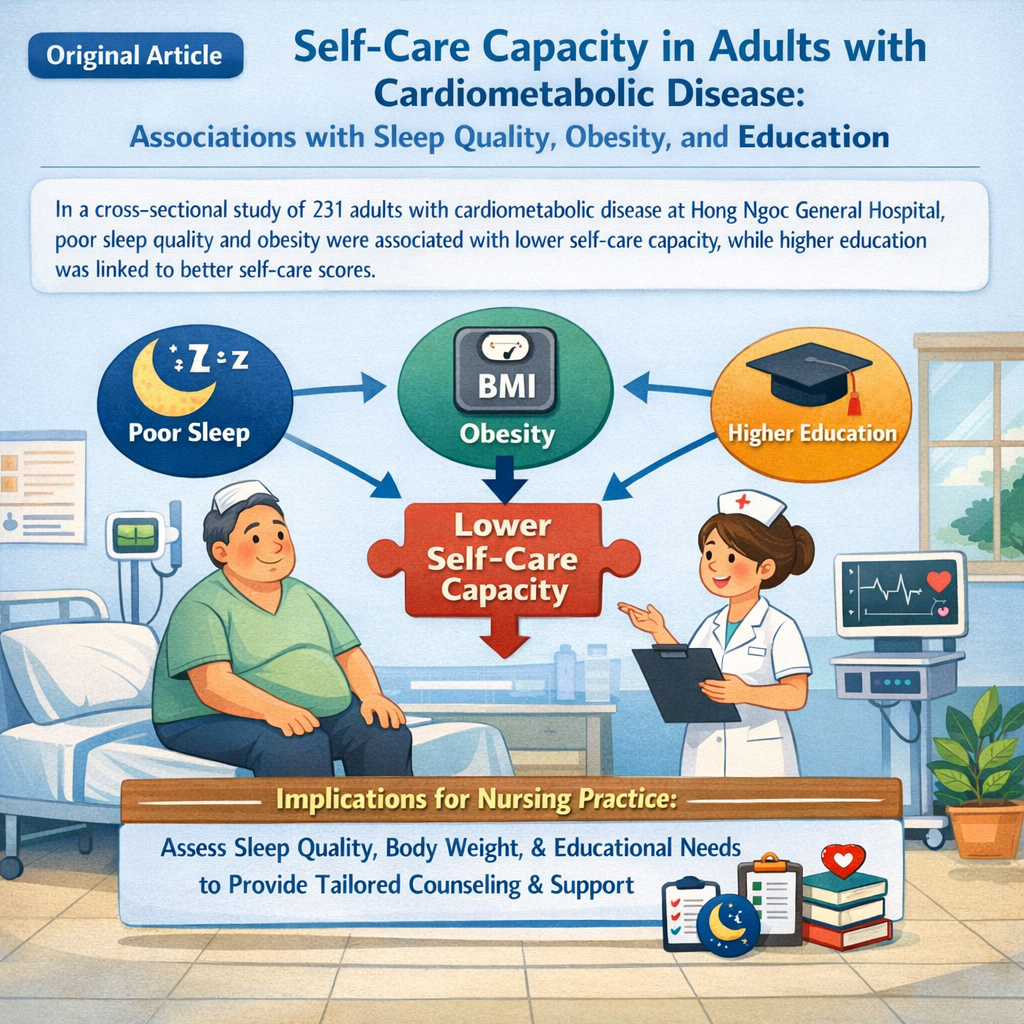
Results: The mean (SD) age was 57.8 (10.6) years, and 127 participants (55.0%) were women. Poor sleep quality (β, −4.12; P<.001) and obesity (β, −2.37; P=.008) were associated with lower self-care capacity, whereas higher education (β, 2.84; P=.004) was associated with better scores.
Conclusions: Poor sleep quality and obesity were associated with lower self-care capacity in adults with cardiometabolic disease, supporting integrated behavioral and risk-based nursing assessment
Implication for Nursing Practice: Nurses may benefit from routinely assessing sleep quality, body weight, and educational needs to identify patients who may require monitoring, tailored counseling, and individualized self-management support within cardiometabolic care pathways
References
Abdallah, S. M. A., Ayoub, A. I., Makhlouf, M. M. E., & Ashour, A. (2024). Diabetes knowledge, health literacy and diabetes self-care among older adults living with diabetes in Alexandria, Egypt. BMC Public Health, 24(1), 2848. DOI: 10.1186/s12889-024-20238-w
Baroni, I., Caruso, R., Dellafiore, F., Arrigoni, C., Fabrizi, D., Luciani, M., Rebora, P., & Ausili, D. (2022). Diabesity in adults with type 2 diabetes mellitus: A cross-sectional study exploring self-care and its determinants. Canadian Journal of Diabetes, 46(7), 662–670.e1. DOI: 10.1016/j.jcjd.2022.03.009
Blüher, M. (2025). An overview of obesity-related complications: The epidemiological evidence linking body weight and other markers of obesity to adverse health outcomes. Diabetes, Obesity and Metabolism, 27(Suppl. 2), 3–19. DOI: 10.1111/dom.16263
Buysse, D. J., Reynolds, C. F., III, Monk, T. H., Berman, S. R., & Kupfer, D. J. (1989). The Pittsburgh Sleep Quality Index: A new instrument for psychiatric practice and research. Psychiatry Research, 28(2), 193–213. DOI: 10.1016/0165-1781(89)90047-4
Bui, P. T. M., Nguyen, T. V., Nguyen, T. Q., Nguyen, C. D., Nguyen, B. V., Hoang, A. M., Vu, T. V., Le, D. M., Nguyen, V. H. N., & Tran, D. V. (2025). Exploring the relationship between sleep quality, obesity, and biochemical markers in elderly outpatients. American Journal of Human Biology, 37(5), e70056. DOI: 10.1002/ajhb.70056
Carpi, M. (2025). The Pittsburgh Sleep Quality Index: A brief review. Occupational Medicine, 75(1), 14–15. DOI: 10.1093/occmed/kqae121
El-Osta, A., Tieu, M., Panzarino, C., Hendriks, J. M. L., Lee, K. Y., Chan, R. J., & Kitson, A. (2023). Tools for measuring individual self-care capability: A scoping review. BMC Public Health, 23(1), 1312. DOI: 10.1186/s12889-023-16194-6
Figorilli, M., Velluzzi, F., & Redolfi, S. (2025). Obesity and sleep disorders: A bidirectional relationship. Nutrition, Metabolism and Cardiovascular Diseases, 35(6), 104014. DOI: 10.1016/j.numecd.2025.104014
Hong Ngoc General Hospital. (n.d.). About Hong Ngoc Hospital. No DOI available.
International Diabetes Federation. (2025). Diabetes data in South-East Asia region.
Jeong, M. (2024). Associations of sleep quality and physical activity with diabetes quality of life in Korean Americans with type 2 diabetes: A cross-sectional study. Healthcare, 12(7), 756. DOI: 10.3390/healthcare12070756
Kassie, G. A., Mekonen, A. G., Abdela, O. A., Hassen, H. Y., & Shibiru, T. (2024). Self-care practices and its associated factors among adult diabetes mellitus patients in public hospitals of Sidama region, Southern Ethiopia: A cross-sectional study. Pan African Medical Journal, 48, 36. DOI: 10.11604/pamj.2024.48.36.41041
Kurnia, A. D., Thato, R., & Tsai, H. T. (2025). Predicting factors of sleep quality among adults with type 2 diabetes mellitus: A systematic review. Diabetes Research and Clinical Practice, 227, 112388. DOI: 10.1016/j.diabres.2025.112388
Martínez, N., Connelly, C. D., Pérez, A., & Calero, P. (2021). Self-care: A concept analysis. International Journal of Nursing Sciences, 8(4), 418–425. DOI: 10.1016/j.ijnss.2021.08.007
Ndumele, C. E., Rangaswami, J., Chow, S. L., Neeland, I. J., Tuttle, K. R., Khan, S. S., Coresh, J., Mathew, R. O., Baker-Smith, C. M., Carnethon, M. R., Despres, J. P., Ho, J. E., Joseph, J. J., Kernan, W. N., Khera, A., Kosiborod, M. N., Lekavich, C. L., Lewis, E. F., Lo, K. B., Ozkan, B., Palaniappan, L. P., Patel, S. S., Pencina, M. J., Powell-Wiley, T. M., Sperling, L. S., Virani, S. S., Wright, J. T., Rajgopal Singh, R., & Elkind, M. S. V. (2023). Cardiovascular-kidney-metabolic health: A presidential advisory from the American Heart Association. Circulation, 148(20), 1606–1635. DOI: 10.1161/CIR.0000000000001184
Okawa, Y., Mitsuhashi, T., & Tsuda, T. (2025). The Asia-Pacific body mass index classification and new-onset chronic kidney disease in non-diabetic Japanese adults: A community-based longitudinal study from 1998 to 2023. Biomedicines, 13(2), 373. DOI: 10.3390/biomedicines13020373
Oliveira, L., Teixeira, A., & Duarte, I. (2022). The Appraisal of Self-Care Agency Scale-Revised (ASAS-R): Reliability and validity among Portuguese medical students. International Journal of Environmental Research and Public Health, 19(17), 10848. DOI: 10.3390/ijerph191710848
Pasinggi, M., Pakki, I. B., & Yadi, Y. (2025). The relationship between lipid profile and HBA1C levels in type 2 diabetes melitus patients. Indonesian Journal of Global Health Research, 7(5), 71–76. DOI: 10.37287/ijghr.v7i5.6629
Putri, S., Ciminata, G., Lewsey, J., Jani, B., McMeekin, N., & Geue, C. (2024). The conceptualisation of cardiometabolic disease policy model in the UK. BMC Health Services Research, 24(1), 1060. DOI: 10.1186/s12913-024-11559-y
Shah, A., Davarci, O., Chaftari, P., & Avenatti, E. (2025). Obesity as a disease: A primer on clinical and physiological insights. Methodist DeBakey Cardiovascular Journal, 21(2), 4–13. DOI: 10.14797/mdcvj.1515
Sousa, V. D., Zauszniewski, J. A., Bergquist-Beringer, S., Musil, C. M., Neese, J. B., & Jaber, A. F. (2010). Reliability, validity and factor structure of the Appraisal of Self-Care Agency Scale-Revised (ASAS-R). Journal of Evaluation in Clinical Practice, 16(6), 1031–1040. DOI: 10.1111/j.1365-2753.2009.01242.x
St-Onge, M.-P., Aggarwal, B., Fernandez-Mendoza, J., Johnson, D. A., Kline, C. E., Knutson, K. L., Redeker, N. S., & Grandner, M. A. (2025). Multidimensional sleep health: Definitions and implications for cardiometabolic health: A scientific statement from the American Heart Association. Circulation: Cardiovascular Quality and Outcomes, 18(5), e000139. DOI: 10.1161/HCQ.0000000000000139
Takahashi, K., Takeishi, C., Tsutsumi, C., Nakao, T., Sato, Y., Uchizono, Y., Nunoi, K., Tabira, Y., & Shimizu, Y. (2025). Exploring the relationship between self-care agency and quality of life in adults with diabetes: A cross-sectional study. PLOS ONE, 20(7), e0326783. DOI: 10.1371/journal.pone.0326783
von Elm, E., Altman, D. G., Egger, M., Pocock, S. J., Gøtzsche, P. C., & Vandenbroucke, J. P. (2007). The Strengthening the Reporting of Observational Studies in Epidemiology (STROBE) statement: Guidelines for reporting observational studies. The Lancet, 370(9596), 1453–1457. DOI: 10.1016/S0140-6736(07)61602-X
World Health Organization. (2024, November 14). Diabetes.
World Health Organization. (2025, July 31). Cardiovascular diseases (CVDs).
World Health Organization. (2025, September 25). Noncommunicable diseases.
World Health Organization. (2025, December 8). Obesity and overweight.
Downloads
Published
How to Cite
Issue
Section
License
Copyright (c) 2026 Nguyễn Thị Ngọc Mai, Phương Bảo Linh

This work is licensed under a Creative Commons Attribution-ShareAlike 4.0 International License.
This work is licensed under a Creative Commons Attribution-ShareAlike 4.0 International License.
You are free to:
Share — copy and redistribute the material in any medium or format
Adapt — remix, transform, and build upon the material for any purpose, even commercially
Under the following terms:
Attribution — You must give appropriate credit, provide a link to the license, and indicate if changes were made. You may do so in any reasonable manner, but not in any way that suggests the licensor endorses you or your use.
ShareAlike — If you remix, transform, or build upon the material, you must distribute your contributions under the same license as the original
No additional restrictions — You may not apply legal terms or technological measures that legally restrict others from doing anything the license permits


 Scopus ID