Empowered Nurses, Safer Care: A Cross-Sectional Study of Work Environment and Patient Safety Culture
Keywords:
hospitals, indonesia, nurses, patient safety, safety cultureAbstract
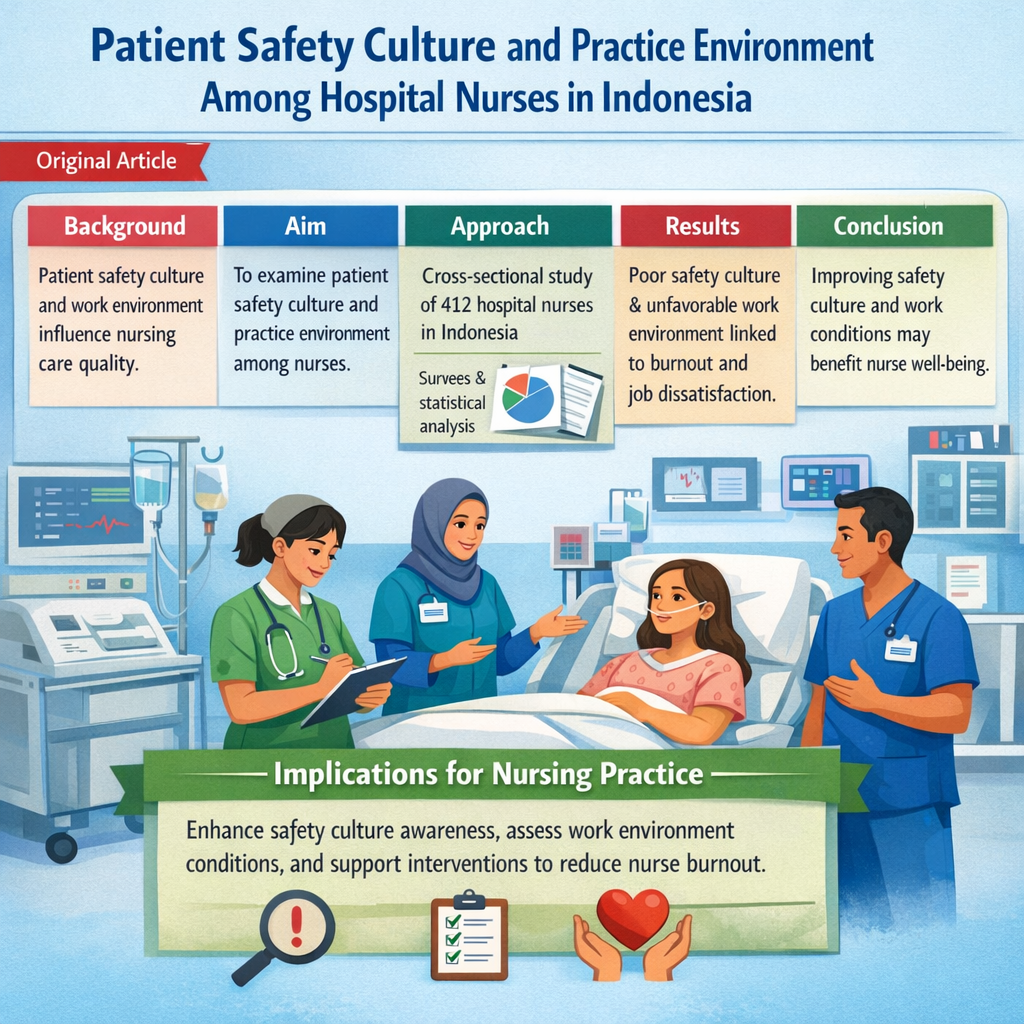
Background: Patient safety culture remains a major concern in hospital care, and the nursing work environment may be associated with safer practice, teamwork, and reporting behavior among clinical nurses
Aim: To examine the association between nurses’ work environment and patient safety culture in a regional hospital in Samarinda, Indonesia
Approach: This cross-sectional study included 124 nurses from an accessible population of 140 at Hospital Dirgahayu Samarinda from January 2 to February 4, 2026. Total population sampling was used. Eligible participants were clinical nurses aged 18 years or older who were actively working during data collection. Work environment and patient safety culture were measured using the Indonesian PES-NWI and HSOPSC 2.0. Data were analyzed using descriptive statistics, bivariate tests, and multivariable linear regression in SPSS version 18.0
Results: The mean (SD) age was 31.8 (5.9) years, and 96 participants (77.4%) were women. The mean (SD) patient safety culture score was 3.54 (0.42), and the mean (SD) work environment score was 2.86 (0.39). In the adjusted model, a more favorable work environment was associated with a higher patient safety culture score (β = 0.41; 95% CI, 0.27 to 0.55; P < .001). Greater nursing experience was also associated with a higher score (β = 0.17; 95% CI, 0.05 to 0.29; P = .006), whereas rotating shift work was associated with a lower score (β = −0.19; 95% CI, −0.35 to −0.03; P = .02)
Conclusions: A more favorable nursing work environment was associated with a more positive patient safety culture among nurses in this hospital setting
Implication for Nursing Practice: Nursing practice may benefit from supportive leadership, adequate staffing, structured orientation, and stronger communication systems to reinforce safety culture, especially among less experienced nurses and rotating-shift staff.
References
Dhamanti, I., Leggat, S., Barraclough, S., & Rachman, T. (2021). Factors contributing to under-reporting of patient safety incidents in Indonesia: Leaders' perspectives. F1000Research, 10, 367. https://doi.org/10.12688/f1000research.51912.2
Dhamanti, I., Leggat, S., Barraclough, S., & Tjahjono, B. (2019). Patient safety incident reporting in Indonesia: An analysis using World Health Organization characteristics for successful reporting. Risk Management and Healthcare Policy, 12, 331–338. https://doi.org/10.2147/RMHP.S222262
Dhingra-Kumar, N., Brusaferro, S., & Arnoldo, L. (2021). Patient safety in the world. In L. Donaldson, W. Ricciardi, S. Sheridan, & R. Tartaglia (Eds.), Textbook of patient safety and clinical risk management (Chap. 8). Springer. https://doi.org/10.1007/978-3-030-59403-9_8
Faridah, I., Setyowati, S., Lestari, F., & Hariyati, R. T. S. (2021). The correlation between work environment and patient safety in a general hospital in Indonesia. Enfermería Clínica, 31(Suppl. 2), S220–S224. https://doi.org/10.1016/j.enfcli.2020.12.026
Ha, T. T. N., Thanh, P. Q., Huong, T. L., Anh, V. T., Tu, N. M., Tien, P. H., & Ha, B. T. T. (2023). Nurses' perceptions about patient safety culture in public hospital in Vietnam. Applied Nursing Research, 69, 151650. https://doi.org/10.1016/j.apnr.2022.151650
Hall-Lord, M. L., Bååth, C., & Nordin, A. (2024). Patient safety culture and teamwork in hospital wards: Registered nurses’ and nursing assistants’ perceptions and attitudes. Nursing Forum, 2024(1), 9410721. https://doi.org/10.1155/nuf/9410721
Harrison, R., Cohen, A. W. S., & Walton, M. (2015). Patient safety and quality of care in developing countries in Southeast Asia: A systematic literature review. International Journal for Quality in Health Care, 27(4), 240–254. https://doi.org/10.1093/intqhc/mzv041
Hayashi, R., Fujita, S., Iida, S., Nagai, Y., Shimamori, Y., & Hasegawa, T. (2020). Relationship of patient safety culture with factors influencing working environment such as working hours, the number of night shifts, and the number of days off among healthcare workers in Japan: A cross-sectional study. BMC Health Services Research, 20, 310. https://doi.org/10.1186/s12913-020-05114-8
Juanamasta, I. G., Aungsuroch, Y., Fisher, M. L., Nuryani, S. N. A., & Ayuningsih, N. N. (2023). Translation and validation study of the Indonesian version of the Practice Environment Scale of the Nursing Work Index. International Journal of Nursing Sciences, 10(4), 511–517. https://doi.org/10.1016/j.ijnss.2023.09.018
Kang, S., Ho, T. T. T., & Lee, N.-J. (2021). Comparative studies on patient safety culture to strengthen health systems among Southeast Asian countries. Frontiers in Public Health, 8, 600216. https://doi.org/10.3389/fpubh.2020.600216
Kusumawati, A. S., Handiyani, H., & Rachmi, S. F. (2019). Patient safety culture and nurses’ attitude on incident reporting in Indonesia. Enfermería Clínica, 29(Suppl. 2), 47–52. https://doi.org/10.1016/j.enfcli.2019.04.007
Lake, E. T., Gil, J., Moronski, L., McHugh, M. D., Aiken, L. H., & Lasater, K. B. (2024). Validation of a short form of the Practice Environment Scale of the Nursing Work Index: The PES-5. Research in Nursing & Health, 47(4), 450–459. https://doi.org/10.1002/nur.22388
Li, L. Z., Yang, P., Singer, S. J., Pfeffer, J., Mathur, M. B., & Shanafelt, T. (2024). Nurse burnout and patient safety, satisfaction, and quality of care: A systematic review and meta-analysis. JAMA Network Open, 7(11), e2443059. https://doi.org/10.1001/jamanetworkopen.2024.43059
Lucas, P., Jesus, É., Almeida, S., & Araújo, B. (2023). Relationship of the nursing practice environment with the quality of care and patients’ safety in primary health care. BMC Nursing, 22(1), 413. https://doi.org/10.1186/s12912-023-01571-8
Malinowska-Lipień, I., Micek, A., Gabryś, T., Kózka, M., Gajda, K., Gniadek, A., Brzostek, T., Fletcher, J., & Squires, A. (2021). Impact of the work environment on patients’ safety as perceived by nurses in Poland—A cross-sectional study. International Journal of Environmental Research and Public Health, 18(22), 12057. https://doi.org/10.3390/ijerph182212057
Membrillo-Pillpe, N. J., Zeladita-Huaman, J. A., Jauregui-Soriano, K., Zegarra-Chapoñan, R., Franco-Chalco, E., & Samillan-Yncio, G. (2023). Association between the nursing practice environment and safety perception with patient safety culture during COVID-19. International Journal of Environmental Research and Public Health, 20(10), 5909. https://doi.org/10.3390/ijerph20105909
Nyberg, A., Olofsson, B., Fagerdahl, A., Haney, M., & Otten, V. (2024). Longer work experience and age associated with safety attitudes in operating room nurses: An online cross-sectional study. BMJ Open Quality, 13(1), e002182. https://doi.org/10.1136/bmjoq-2022-002182
Olsen, E., Addo, S. A. J., Hernes, S. S., Christiansen, M. H., Haugen, A. S., & Leonardsen, A.-C. L. (2024). Psychometric properties and criterion related validity of the Norwegian version of hospital survey on patient safety culture 2.0. BMC Health Services Research, 24(1), 642. https://doi.org/10.1186/s12913-024-11097-7
Pereira, S. C. de A., Ribeiro, O. M. P. L., Fassarella, C. S., & Santos, E. J. F. (2024). The impact of nursing practice environments on patient safety culture in primary health care: A scoping review. BJGP Open, 8(1), BJGPO.2023.0062. https://doi.org/10.3399/BJGPO.2023.0062
Rusdi, R., Said, F. M., & Umar, N. S. (2024). The effect of empowerment to improve patient safety culture among hospital nurses. International Journal of Public Health Science, 13(4), 1903–1911. https://doi.org/10.11591/ijphs.v13i4.24418
Suryani, L., Letchmi, S., & Said, F. B. M. (2022). Cross-culture adaptation and validation of the Indonesian version of the Hospital Survey on Patient Safety Culture (HSOPSC 2.0). Belitung Nursing Journal, 8(2), 169–175. https://doi.org/10.33546/bnj.1928
Vandela, Z. K., Nurhasanah, N., & Purwaningsih, E. (2025). The influence of safety culture on patient safety among nurses at I. A. Moeis Regional General Hospital, Samarinda in 2024. International Journal of Economics and Management Research, 4(3), 447–455. https://doi.org/10.55606/ijemr.v4i3.571
Vikan, M., Haugen, A. S., Bjørnnes, A. K., Valeberg, B. T., Deilkås, E. C. T., & Danielsen, S. O. (2023). The association between patient safety culture and adverse events - a scoping review. BMC Health Services Research, 23(1), 300. https://doi.org/10.1186/s12913-023-09332-8
von Elm, E., Altman, D. G., Egger, M., Pocock, S. J., Gøtzsche, P. C., & Vandenbroucke, J. P. (2007). The Strengthening the Reporting of Observational Studies in Epidemiology (STROBE) statement: Guidelines for reporting observational studies. The Lancet, 370(9596), 1453–1457. https://doi.org/10.1016/S0140-6736(07)61602-X
Downloads
Published
How to Cite
Issue
Section
License
Copyright (c) 2026 Diana Oktaria, Sabrina Jalaila, Indah Susanti, Asmat Burhan

This work is licensed under a Creative Commons Attribution-ShareAlike 4.0 International License.
This work is licensed under a Creative Commons Attribution-ShareAlike 4.0 International License.
You are free to:
Share — copy and redistribute the material in any medium or format
Adapt — remix, transform, and build upon the material for any purpose, even commercially
Under the following terms:
Attribution — You must give appropriate credit, provide a link to the license, and indicate if changes were made. You may do so in any reasonable manner, but not in any way that suggests the licensor endorses you or your use.
ShareAlike — If you remix, transform, or build upon the material, you must distribute your contributions under the same license as the original
No additional restrictions — You may not apply legal terms or technological measures that legally restrict others from doing anything the license permits


 Scopus ID