Moral Distress and Burnout among Intensive Care Unit Nurses: A Cross-Sectional Study
Keywords:
burnout, professional, cross-sectional studies, critical care nursing, ethical dilemmas, intensive care units, nursesAbstract
Background: Burnout and moral distress are important occupational problems among intensive care unit nurses and may compromise staff well-being, workforce stability, and the quality of patient care
Aims: To assess burnout and examine its association with moral distress among intensive care unit nurses.
Methods: This cross-sectional study was conducted among intensive care unit nurses at RSU Mitra Medika Premiere, Medan, Indonesia, from August 13 to September 13, 2025. Of 80 eligible nurses, 64 were included in the final analysis. Data were collected using structured self-administered questionnaires. Multivariable logistic regression was used to examine factors associated with burnout.
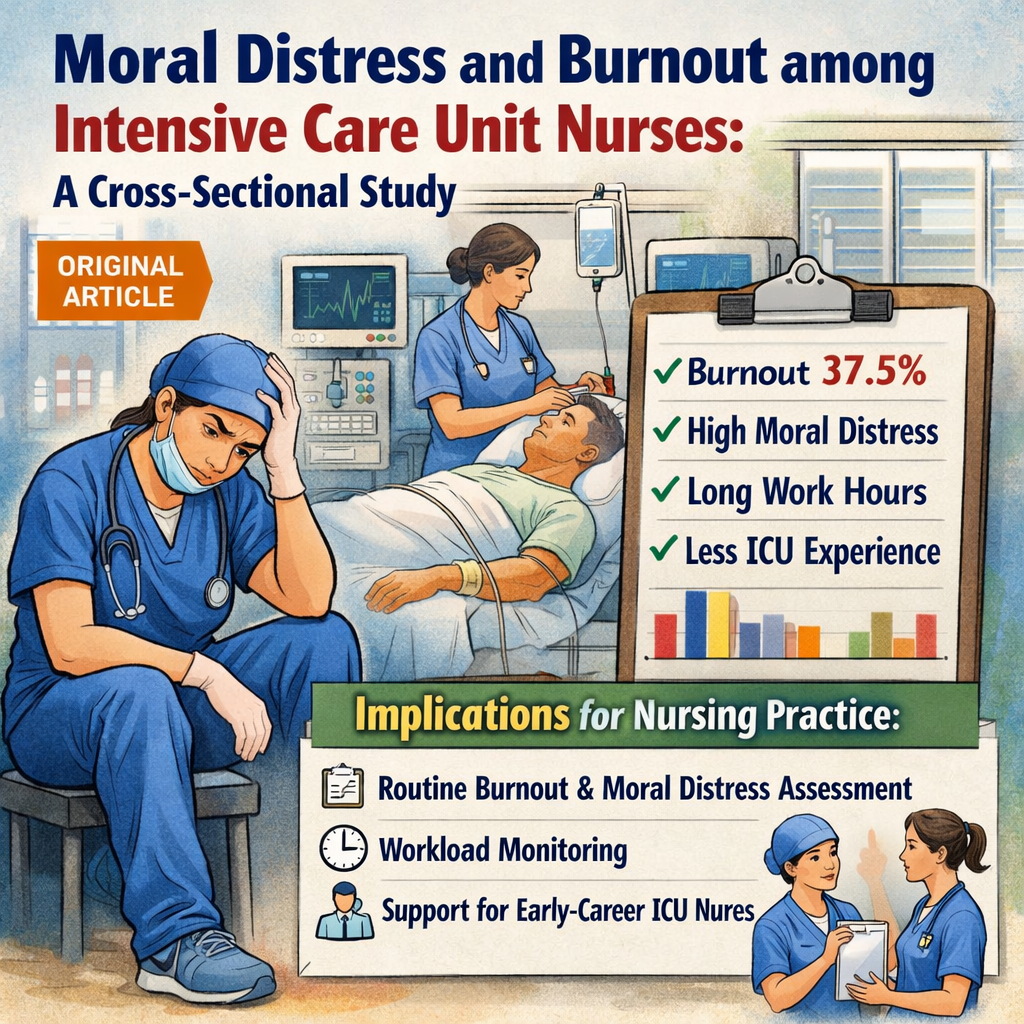
Results: Burnout was identified in 24 of 64 nurses (37.5%). In adjusted analyses, higher moral distress was associated with greater odds of burnout (adjusted odds ratio [aOR], 3.94; 95% CI, 1.15-13.46; P = .029). Working at least 48 hours per week (aOR, 3.08; 95% CI, 1.01-9.38; P = .047) and having less than 5 years of intensive care unit experience (aOR, 2.79; 95% CI, 1.00-7.81; P = .049) were also associated with burnout
Conclusion: Burnout was common among intensive care unit nurses and was associated with moral distress, longer weekly work hours, and shorter intensive care unit experience.
Implication for nursing practice: Routine assessment of burnout and moral distress, workload monitoring, and targeted support for early-career intensive care unit nurses may help strengthen staff well-being and maintain care quality
References
Andersson, M., Fredholm, A., Nordin, A., & Engström, Å. (2023). Moral distress, health and intention to leave: Critical care nurses’ perceptions during COVID-19 pandemic. SAGE Open Nursing, 9, 23779608231169218. DOI: 10.1177/23779608231169218
Cerela-Boltunova, O., Millere, I., & Nagle, E. (2025). Moral distress, professional burnout, and potential staff turnover in intensive care nursing practice in Latvia-Phase 1. International Journal of Environmental Research and Public Health, 22(8), 1261. DOI: 10.3390/ijerph22081261
Chai, F., Hu, W., Xu, D., Ji, Y., Wang, Y., Xu, C., & Li, X. (2026). The relationship between moral distress and occupational burnout among ICU nurses: Social support and psychological resilience as mediating variables. Frontiers in Public Health, 13, 1743774. DOI: 10.3389/fpubh.2025.1743774
Dall’Ora, C., Ejebu, O.-Z., Ball, J., & Griffiths, P. (2023). Shift work characteristics and burnout among nurses: Cross-sectional survey. Occupational Medicine, 73(4), 199–204. DOI: 10.1093/occmed/kqad046
Getie, A., Ayenew, T., Amlak, B. T., Gedfew, M., Edmealem, A., & Kebede, W. M. (2025). Global prevalence and contributing factors of nurse burnout: An umbrella review of systematic review and meta-analysis. BMC Nursing, 24(1), 596. DOI: 10.1186/s12912-025-03266-8
Giannetta, N., Villa, G., Bonetti, L., Dionisi, S., Pozza, A., Rolandi, S., Rosa, D., & Manara, D. F. (2022). Moral distress scores of nurses working in intensive care units for adults using Corley’s scale: A systematic review. International Journal of Environmental Research and Public Health, 19(17), 10640. DOI: 10.3390/ijerph191710640
Kok, N., Van Gurp, J., van der Hoeven, J. G., Fuchs, M., Hoedemaekers, C., & Zegers, M. (2023). Complex interplay between moral distress and other risk factors of burnout in ICU professionals: Findings from a cross-sectional survey study. BMJ Quality & Safety, 32(4), 225–234. DOI: 10.1136/bmjqs-2020-012239
Li, L. Z., Yang, P., Singer, S. J., Pfeffer, J., Mathur, M. B., & Shanafelt, T. (2024). Nurse burnout and patient safety, satisfaction, and quality of care: A systematic review and meta-analysis. JAMA Network Open, 7(11), e2443059. DOI: 10.1001/jamanetworkopen.2024.43059
McAndrew, N. S., Leske, J., & Schroeter, K. (2018). Moral distress in critical care nursing: The state of the science. Nursing Ethics, 25(5), 552–570. DOI: 10.1177/0969733016664975
Qu, K.-Y., Zhu, D.-J., Yang, P.-F., Huo, H.-J., Liu, H.-J., Min, Z., Zhu, Y., Wang, Y.-H., Hong, C., & Zhu, J.-Q. (2026). Moral distress of intensive care unit nurses: A systematic review and meta-analysis. BMC Nursing, 25(1), 108. DOI: 10.1186/s12912-025-04274-4
Salas-Bergüés, V., Pereira-Sánchez, M., Martín-Martín, J., & Olano-Lizarraga, M. (2024). Development of burnout and moral distress in intensive care nurses: An integrative literature review. Enfermería Intensiva (English ed.), 35(4), 376–409. DOI: 10.1016/j.enfie.2024.02.002
Vandenbroucke, J. P., von Elm, E., Altman, D. G., Gøtzsche, P. C., Mulrow, C. D., Pocock, S. J., Poole, C., Schlesselman, J. J., Egger, M., & STROBE Initiative. (2007). Strengthening the Reporting of Observational Studies in Epidemiology (STROBE): Explanation and elaboration. PLoS Medicine, 4(10), e297. DOI: 10.1371/journal.pmed.0040297
Published
How to Cite
Issue
Section
License
Copyright (c) 2026 Nursing Science Studies

This work is licensed under a Creative Commons Attribution-NonCommercial-ShareAlike 4.0 International License.
This work is licensed under a Creative Commons Attribution-ShareAlike 4.0 International License.
You are free to:
Share — copy and redistribute the material in any medium or format
Adapt — remix, transform, and build upon the material for any purpose, even commercially
Under the following terms:
Attribution — You must give appropriate credit, provide a link to the license, and indicate if changes were made. You may do so in any reasonable manner, but not in any way that suggests the licensor endorses you or your use.
ShareAlike — If you remix, transform, or build upon the material, you must distribute your contributions under the same license as the original
No additional restrictions — You may not apply legal terms or technological measures that legally restrict others from doing anything the license permits


 Scopus ID