
Compression Therapy Competence, Patient Education Practices, and Guideline Adherence in Venous Leg Ulcer Nursing Care: A Cross-Sectional Mediation Study
DOI:
https://doi.org/10.70196/jwrt.v3i1.90Keywords:
compression therapy, guideline adherence, nursing care, patient education, venous leg ulcer, wound healingAbstract
Background: Guideline adherence in venous leg ulcer nursing care requires technical competence, structured patient education, and consistent wound assessment. However, evidence on how compression therapy competence relates to adherence through patient education practices remains limited in hospital-based nursing settings
Aim: To examine factors associated with guideline adherence and the mediating role of patient education practices among nurses
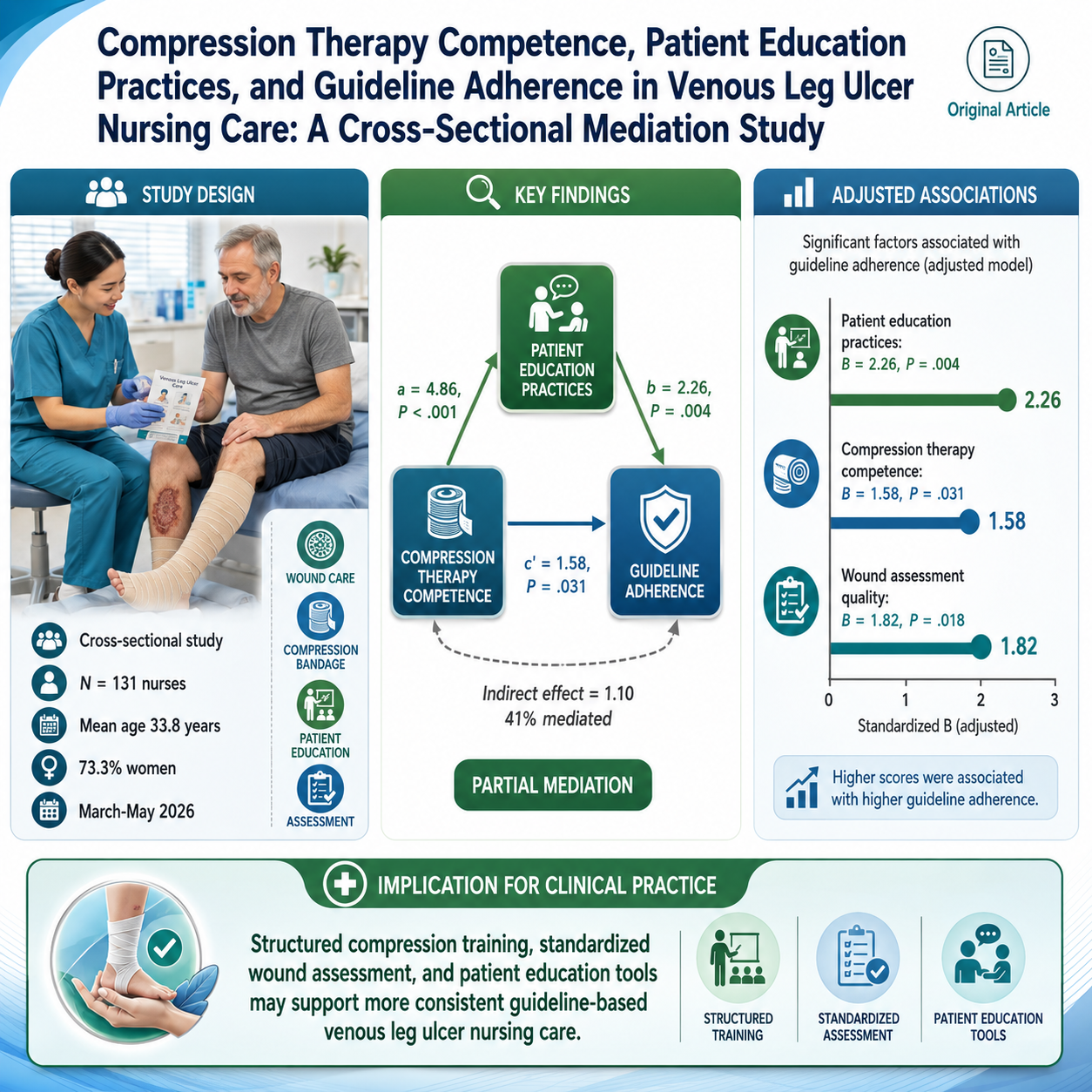
Approach: This cross-sectional study included 131 nurses recruited by consecutive sampling from March to May 2026. Eligible participants were registered nurses involved in venous leg ulcer or wound-related care. Linear regression and mediation analysis were used to examine adjusted associations
Results: Total nurses who completed the study was 131. The mean (SD) age was 33.8 (6.7) years, and 96 participants (73.3%) were women. The mean (SD) guideline adherence score was 74.6 (9.8). Higher patient education practices were associated with guideline adherence (adjusted B, 2.26; 95% CI, 0.73-3.79; P = .004), as were compression therapy competence (adjusted B, 1.58; 95% CI, 0.15-3.01; P = .031) and wound assessment quality (adjusted B, 1.82; 95% CI, 0.32-3.32; P = .018). Patient education practices partially mediated the association between compression therapy competence and guideline adherence
Conclusions: Compression therapy competence, patient education practices, and wound assessment quality were associated with guideline adherence in venous leg ulcer nursing care
Implication for Nursing Practice: Structured compression training, standardized wound assessment, and patient education checklists may support more consistent venous leg ulcer nursing care, although longitudinal evidence is needed
Downloads
References
Attaran, R. R., Edwards, M. L., Bunte, M. C., Arena, F. J., Carr, J. G., Kim, P., & Parikh, S. A. (2025). 2025 SCAI clinical practice guidelines for the management of chronic venous disease. Journal of the Society for Cardiovascular Angiography & Interventions, 4(8), 103729. doi: 10.1016/j.jscai.2025.103729
Baron, R. M., & Kenny, D. A. (1986). The moderator–mediator variable distinction in social psychological research: Conceptual, strategic, and statistical considerations. Journal of Personality and Social Psychology, 51(6), 1173–1182. doi: 10.1037/0022-3514.51.6.1173
Behairy, A. S., & Masry, S. E. (2022). Impact of educational nursing intervention on compression therapy adherence and recurrence of venous leg ulcers: A quasi-experimental study. Ophthalmic Research, 8(2), 120–132. doi: 10.1159/000521054
Bernatchez, S. F., Eysaman-Walker, J., & Weir, D. (2022). Venous leg ulcers: A review of published assessment and treatment algorithms. Advances in Wound Care, 11(1), 28–41. doi: 10.1089/wound.2020.1381
Bobbink, P., Gschwind, G., Probst, S., & others. (2025). Making conscientious decisions: Engaging in venous leg ulcer self-management following nurse-led patient education. Qualitative Health Research, 35(8–9), 901–915. doi: 10.1177/10497323241285692
Faul, F., Erdfelder, E., Buchner, A., & Lang, A.-G. (2009). Statistical power analyses using G*Power 3.1: Tests for correlation and regression analyses. Behavior Research Methods, 41(4), 1149–1160. doi: 10.3758/BRM.41.4.1149
Freeman, S., Tzeng, H.-M., & others. (2025). Use of artificial intelligence-driven wound care management to enhance access to care in rural and northern communities. International Wound Journal, 22(10), e70767. doi: 10.1111/iwj.70767
He, B., Shi, J., Li, L., & others. (2024). Prevention strategies for the recurrence of venous leg ulcers: A scoping review. International Wound Journal, 21(3), e14759. doi: 10.1111/iwj.14759
Jiménez, D. R., Reifs, J., Casanova-Lozano, L., Grau-Carrión, S., Sbert, M., & others. (2025). Artificial intelligence methods for diagnostic and decision-making assistance in chronic wounds: A systematic review. Journal of Medical Systems, 49, 29. doi: 10.1007/s10916-025-02153-8
Jung, M.-J., & Roh, Y.-S. (2021). A validation study of the Korean version of the Nurses’ Patient Education Questionnaire. International Journal of Environmental Research and Public Health, 18(11), 5609. doi: 10.3390/ijerph18115609
Krizanova, O., Penesova, A., Hokynkova, A., Pokorna, A., Samadian, A., & Babula, P. (2024). Chronic venous insufficiency and venous leg ulcers: Aetiology, on the pathophysiology-based treatment. International Wound Journal, 21(2), e14405. doi: 10.1111/iwj.14405
Liu, H., Li, X., Zhang, Y., & others. (2025). Current status, challenges, and prospects of artificial intelligence in wound care. Burns & Trauma, 13, tkae068. doi: 10.1093/burnst/tkae068
MacKinnon, D. P., Lockwood, C. M., & Williams, J. (2004). Confidence limits for the indirect effect: Distribution of the product and resampling methods. Multivariate Behavioral Research, 39(1), 99–128. doi: 10.1207/s15327906mbr3901_4
Mohammed, H. T., Corcoran, K., Lavergne, K., Graham, A., Gill, D., Jones, K., Singal, S., Krishnamoorthy, M., Cassata, A., Mannion, D., & Fraser, R. D. J. (2025). Clinical, operational, and economic benefits of a digitally enabled wound care program in home health: Quasi-experimental, pre-post comparative study. JMIR Nursing, 8, e71535. doi: 10.2196/71535
Nair, B. (2014). Compression therapy for venous leg ulcers. Indian Dermatology Online Journal, 5(3), 378–382. doi: 10.4103/2229-5178.137819
Norman, C. D., & Skinner, H. A. (2006). eHEALS: The eHealth Literacy Scale. Journal of Medical Internet Research, 8(4), e27. doi: 10.2196/jmir.8.4.e27
O’Meara, S., Cullum, N., Nelson, E. A., & Dumville, J. C. (2012). Compression for venous leg ulcers. Cochrane Database of Systematic Reviews, 2012(11), CD000265. doi: 10.1002/14651858.CD000265.pub3
Patton, D., Avsar, P., Sayeh, A., O’Connor, T., Walsh, S., Nugent, L., Harkin, D., O’Brien, N., Cayce, J., Corcoran, M., Gaztambide, M., & Moore, Z. (2024). A systematic review of the impact of compression therapy on quality of life and pain among people with a venous leg ulcer. International Wound Journal, 21(3), e14816. doi: 10.1111/iwj.14816
Pennisi, Y., Müller, N., Buckley, C., Hartigan, I., & Murphy, S. (2024). Self-management to prevent recurrence in venous leg ulcers: A concept analysis. International Wound Journal, 21(6), e14944. doi: 10.1111/iwj.14944
Pennisi, Y., Müller, N., Buckley, C., Murphy, S., & Hartigan, I. (2025). Self-management to prevent venous leg ulcer recurrence: A scoping review. Wound Practice and Research, 33(1), 18–31. doi: 10.33235/wpr.33.1.18-31
Perry, C., Atkinson, R. A., Griffiths, J., Wilson, P. M., Lavallée, J. F., Cullum, N., & Dumville, J. C. (2023). Barriers and facilitators to use of compression therapy by people with venous leg ulcers: A qualitative exploration. Journal of Advanced Nursing, 79(7), 2568–2584. doi: 10.1111/jan.15608
Preacher, K. J., & Hayes, A. F. (2008). Asymptotic and resampling strategies for assessing and comparing indirect effects in multiple mediator models. Behavior Research Methods, 40(3), 879–891. doi: 10.3758/BRM.40.3.879
Probst, S., Weller, C. D., Bobbink, P., Saini, C., Pugliese, M., Skinner, M. B., & others. (2023). Prevalence and incidence of venous leg ulcers: A systematic review and meta-analysis. International Wound Journal, 20(9), 3906–3921. doi: 10.1111/iwj.14272
Stacey, M. C., Sibbald, R. G., Evans, R., Arputhanathan, H., Beaumier, M., Handfield, S., Kuhnke, J. L., Queen, D., & others. (2025). Canadian consensus statement for the management of venous leg ulcers. International Wound Journal, 22(4), e70415. doi: 10.1111/iwj.70415
Upton, D., & Upton, P. (2006). Development of an evidence-based practice questionnaire for nurses. Journal of Advanced Nursing, 53(4), 454–458. doi: 10.1111/j.1365-2648.2006.03739.x
Valesky, E. M., Stücker, M., Altmeyer, P., & others. (2024). Diagnosis and treatment of venous leg ulcers: S2k guideline of the German Society of Phlebology and Lymphology. JDDG: Journal der Deutschen Dermatologischen Gesellschaft, 22(7), 1039–1051. doi: 10.1111/ddg.15415
VanderWeele, T. J. (2016). Mediation analysis: A practitioner’s guide. Annual Review of Public Health, 37, 17–32. doi: 10.1146/annurev-publhealth-032315-021402
von Elm, E., Altman, D. G., Egger, M., Pocock, S. J., Gøtzsche, P. C., & Vandenbroucke, J. P., for the STROBE Initiative. (2007). The Strengthening the Reporting of Observational Studies in Epidemiology statement: Guidelines for reporting observational studies. PLOS Medicine, 4(10), e296. doi: 10.1371/journal.pmed.0040296
Weller, C. D., Buchbinder, R., & Johnston, R. V. (2016). Interventions for helping people adhere to compression treatments for venous leg ulceration. Cochrane Database of Systematic Reviews, 2016(3), CD008378. doi: 10.1002/14651858.CD008378.pub3
Wijaya, M. C., & Kloping, Y. P. (2021). Validity and reliability testing of the Indonesian version of the eHealth Literacy Scale during the COVID-19 pandemic. Health Informatics Journal, 27(1), 1460458220975466. doi: 10.1177/1460458220975466
Ylönen, M., Stolt, M., Leino-Kilpi, H., & Suhonen, R. (2014). Nurses’ knowledge about venous leg ulcer care: A literature review. International Nursing Review, 61(2), 194–202. doi: 10.1111/inr.12088
Yoon, J., & others. (2025). Practical management of venous leg ulcers: Guideline-based clinical approach. Annals of Phlebology, 23(1), 1–11. doi: 10.5758/ap.2025.23.1.1
Youssef, N., Alshammari, F., & others. (2023). The internal reliability and construct validity of the Evidence-Based Practice Questionnaire among emergency medical services health care professionals. Healthcare, 11(15), 2168. doi: 10.3390/healthcare11
Downloads
Published
How to Cite
Issue
Section
License
Copyright (c) 2026 Asmat Burhan, Hadi Kusuma, Rubiyanto Warja, Asrizal

This work is licensed under a Creative Commons Attribution-ShareAlike 4.0 International License.