
Burnout in Nursing Home Wound Care Nurses: The Role of Workplace and Individual Factors in a Multicenter Study
DOI:
https://doi.org/10.70196/jwrt.v3i1.87Keywords:
burnout, nursing homes, wound care, nurses, occupational stress, work-life balance, self-efficacy, resilienceAbstract
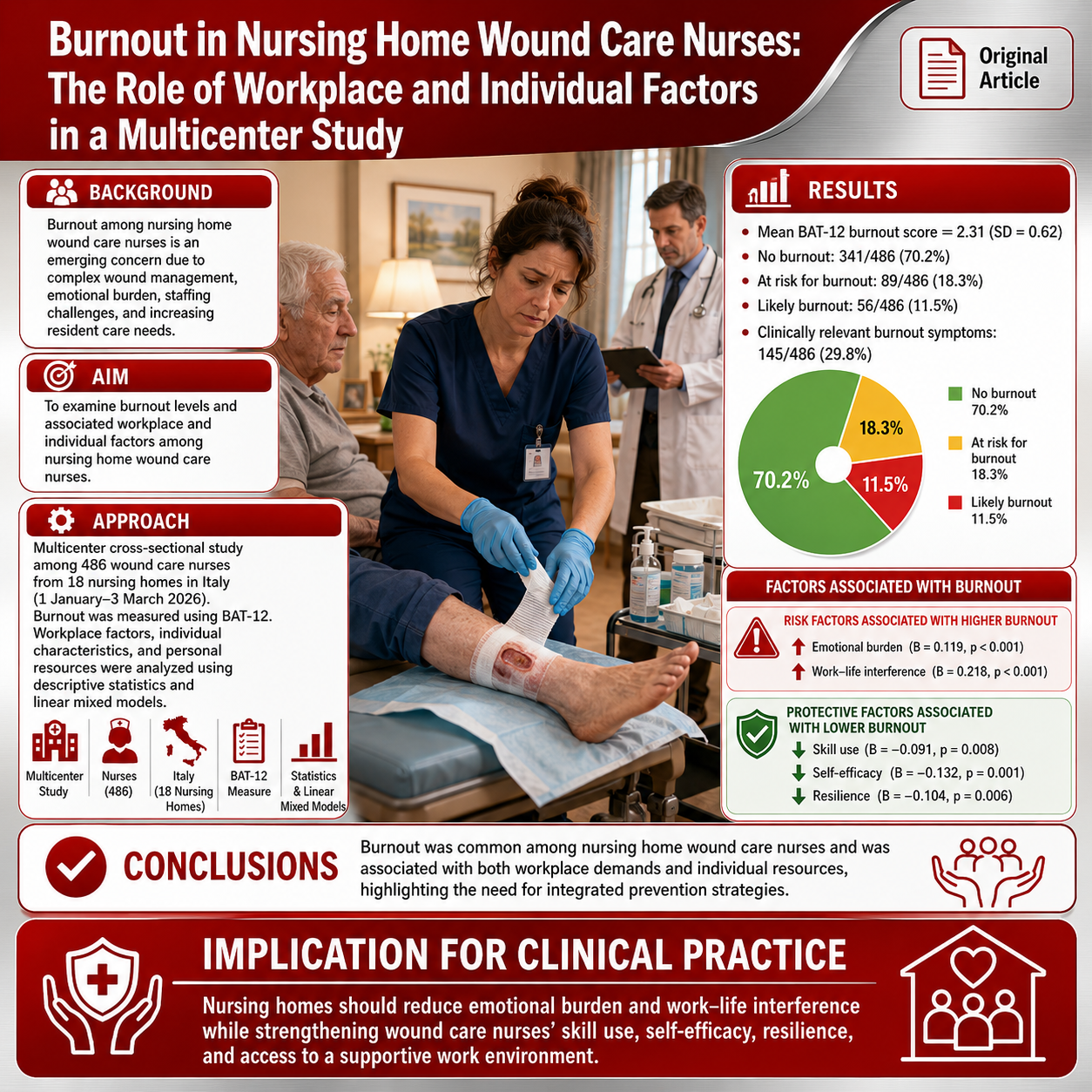
Background: Burnout among nursing home wound care nurses is an emerging concern due to complex wound management, emotional burden, staffing challenges, and increasing resident care needs.
Aim: To examine burnout levels and associated workplace and individual factors among nursing home wound care nurses
Approach: A multicenter cross-sectional study was conducted among 486 wound care nurses from 18 nursing homes in Italy between 1 January and 3 March 2026. Burnout was measured using the BAT-12. Workplace factors, individual characteristics, and personal resources were analyzed using descriptive statistics and linear mixed models
Results: The mean BAT-12 burnout score was 2.31 (SD = 0.62). Of 486 wound care nurses, 341 (70.2%) had no burnout, 89 (18.3%) were at risk for burnout, and 56 (11.5%) were likely suffering from burnout; overall, 145 (29.8%) had clinically relevant burnout symptoms. In the final model, emotional burden (B = 0.119, p < 0.001) and work-life interference (B = 0.218, p < 0.001) were associated with higher burnout, while skill use (B = −0.091, p = 0.008), self-efficacy (B = −0.132, p = 0.001), and resilience (B = −0.104, p = 0.006) were protective.
Conclusions: Burnout was common among nursing home wound care nurses and was associated with both workplace demands and individual resources, highlighting the need for integrated prevention strategies
Implication for Nursing Practice: Nursing homes should reduce emotional burden and work-life interference while strengthening wound care nurses’ skill use, self-efficacy, resilience, and access to supportive work environment
Downloads
References
Aiken, L. H., & Patrician, P. A. (2000). Measuring organizational traits of hospitals: The revised Nursing Work Index. Nursing Research, 49(3), 146–153. https://doi.org/10.1097/00006199-200005000-00006
Albers, G., Van den Block, L., & Vander Stichele, R. (2014). The burden of caring for people with dementia at the end of life in nursing homes: A postdeath study among nursing staff. International Journal of Older People Nursing, 9(2), 106–117. https://doi.org/10.1111/opn.12050
Aleo, G., Pagnucci, N., Walsh, N., Watson, R., Lang, D., Kearns, T., White, M., & Fitzgerald, C. (2024). The effectiveness of continuing professional development for the residential long-term care workforce: A systematic review. Nurse Education Today, 137, 106161. https://doi.org/10.1016/j.nedt.2024.106161
Bakker, A. B., & de Vries, J. D. (2021). Job demands–resources theory and self-regulation: New explanations and remedies for job burnout. Anxiety, Stress, & Coping, 34(1), 1–21. https://doi.org/10.1080/10615806.2020.1797695
Bakker, A. B., Demerouti, E., & Sanz-Vergel, A. (2023). Job demands–resources theory: Ten years later. Annual Review of Organizational Psychology and Organizational Behavior, 10, 25–53. https://doi.org/10.1146/annurev-orgpsych-120920-053933
Castillo-González, A., Velando-Soriano, A., De La Fuente-Solana, E. I., Martos-Cabrera, M. B., Membrive-Jiménez, M. J., Lucía, R. B., & Cañadas-De La Fuente, G. A. (2024). Relation and effect of resilience on burnout in nurses: A literature review and meta-analysis. International Nursing Review, 71(1), 160–167. https://doi.org/10.1111/inr.12838
Cohen, C., Pignata, S., Bezak, E., Tie, M., & Childs, J. (2023). Workplace interventions to improve well-being and reduce burnout for nurses, physicians and allied healthcare professionals: A systematic review. BMJ Open, 13(6), e071203. https://doi.org/10.1136/bmjopen-2022-071203
Demerouti, E., Nachreiner, F., Bakker, A. B., & Schaufeli, W. B. (2001). The job demands–resources model of burnout. Journal of Applied Psychology, 86(3), 499–512. https://doi.org/10.1037/0021-9010.86.3.499
Edvardsson, D., Fetherstonhaugh, D., Nay, R., & Gibson, S. (2010). Development and initial testing of the Person-centered Care Assessment Tool (P-CAT). International Psychogeriatrics, 22(1), 101–108. https://doi.org/10.1017/S1041610209990688
Geyskens, L., Khan, N., Declercq, A., Godderis, L., Heeren, P., Janssens, L., Özkan, Ş., Trybou, J., Vlaeyen, E., Zúñiga, F., Milisen, K., & Deschodt, M. (2026). Burnout levels among nursing home care workers and its associations with workplace and individual factors: Results from a multicenter cross-sectional study. International Journal of Nursing Studies, 177, 105367. https://doi.org/10.1016/j.ijnurstu.2026.105367
Hadžibajramović, E., Schaufeli, W., & De Witte, H. (2022). Shortening of the Burnout Assessment Tool (BAT)—From 23 to 12 items using content and Rasch analysis. BMC Public Health, 22, 560. https://doi.org/10.1186/s12889-022-12946-y
Han, S. J., & Yeun, Y. R. (2023). Psychological intervention to promote resilience in nurses: A systematic review and meta-analysis. Healthcare, 12(1), 73. https://doi.org/10.3390/healthcare12010073
Haynes, C. E., Wall, T. D., Bolden, R., Stride, C., & Rick, J. (1999). Measures of perceived work characteristics for health services research: Test of a measurement model and normative data. British Journal of Health Psychology, 4(3), 257–275. https://doi.org/10.1348/135910799168614
Kopelman, R. E., Greenhaus, J. H., & Connolly, T. F. (1983). A model of work, family, and interrole conflict: A construct validation study. Organizational Behavior and Human Decision Processes, 32(2), 198–215. https://doi.org/10.1016/0030-5073(83)90147-2
Lake, E. T. (2002). Development of the Practice Environment Scale of the Nursing Work Index. Research in Nursing & Health, 25(3), 176–188. https://doi.org/10.1002/nur.10032
Nakagawa, S., & Schielzeth, H. (2013). A general and simple method for obtaining R² from generalized linear mixed-effects models. Methods in Ecology and Evolution, 4(2), 133–142. https://doi.org/10.1111/j.2041-210x.2012.00261.x
Norman, R. M., Iversen, H. H., & Sjetne, I. S. (2019). Development, adaptation and psychometric assessment of the extended Brisbane Practice Environment Measure for nursing homes (B-PEM-NH) for use in the Norwegian setting. Geriatric Nursing, 40(3), 302–313. https://doi.org/10.1016/j.gerinurse.2018.11.007
Notelaers, G., De Witte, H., Veldhoven, M., & Vermunt, J. K. (2007). Construction and validation of the Short Inventory to Monitor Psychosocial Hazards. Arbeid & Ergonomie, 44, 11–17.
Nunnally, J. C., & Bernstein, I. H. (1994). Psychometric theory (3rd ed.). McGraw-Hill.
Patterson, M. G., West, M. A., Shackleton, V. J., Dawson, J. F., Lawthom, R., Maitlis, S., Robinson, D. L., & Wallace, A. M. (2005). Validating the Organizational Climate Measure: Links to managerial practices, productivity and innovation. Journal of Organizational Behavior, 26(4), 379–408. https://doi.org/10.1002/job.312
Peeters, M. C. W., Buunk, B. P., & Schaufeli, W. B. (1995). Social interactions, stressful events and negative affect at work: A micro-analytic approach. European Journal of Social Psychology, 25(4), 391–401. https://doi.org/10.1002/ejsp.2420250404
Polit, D. F., & Beck, C. T. (2006). The content validity index: Are you sure you know what is being reported? Critique and recommendations. Research in Nursing & Health, 29(5), 489–497. https://doi.org/10.1002/nur.20147
Rigotti, T., Schyns, B., & Mohr, G. (2008). A short version of the Occupational Self-Efficacy Scale: Structural and construct validity across five countries. Journal of Career Assessment, 16(2), 238–255. https://doi.org/10.1177/1069072707305763
Schaufeli, W. B., Desart, S., & De Witte, H. (2020). Burnout Assessment Tool (BAT)—Development, validity, and reliability. International Journal of Environmental Research and Public Health, 17(24), 9495. https://doi.org/10.3390/ijerph17249495
Schaufeli, W. B., De Witte, H., & Desart, S. (2023). Burnout Assessment Tool (BAT): Test manual. KU Leuven.
Sexton, J. B., Helmreich, R. L., Neilands, T. B., Rowan, K., Vella, K., Boyden, J., Roberts, P. R., & Thomas, E. J. (2006). The Safety Attitudes Questionnaire: Psychometric properties, benchmarking data, and emerging research. BMC Health Services Research, 6, 44. https://doi.org/10.1186/1472-6963-6-44
Shoji, K., Cieslak, R., Smoktunowicz, E., Rogala, A., Benight, C. C., & Luszczynska, A. (2016). Associations between job burnout and self-efficacy: A meta-analysis. Anxiety, Stress, & Coping, 29(4), 367–386. https://doi.org/10.1080/10615806.2015.1058369
Smith, B. W., Dalen, J., Wiggins, K., Tooley, E., Christopher, P., & Bernard, J. (2008). The Brief Resilience Scale: Assessing the ability to bounce back. International Journal of Behavioral Medicine, 15(3), 194–200. https://doi.org/10.1080/10705500802222972
ten Brummelhuis, L. L., & Bakker, A. B. (2012). A resource perspective on the work-home interface: The Work-Home Resources model. American Psychologist, 67(7), 545–556. https://doi.org/10.1037/a0027974
ten Klooster, P. M., Weekers, A. M., Eggelmeijer, F., van Woerkom, J. M., Drossaert, C. H. C., Taal, E., & van de Laar, M. A. F. J. (2010). Optimisme en/of pessimisme: Factorstructuur van de Nederlandse Life Orientation Test-Revised. Psychologie & Gezondheid, 38(2), 89–100. https://doi.org/10.1007/BF03089356
Tims, M., Bakker, A. B., & Derks, D. (2013). The impact of job crafting on job demands, job resources, and well-being. Journal of Occupational Health Psychology, 18(2), 230–240. https://doi.org/10.1037/a0032141
Van der Heijden, B. I. J. M., Mulder, R. H., König, C., & Anselmann, V. (2019). Toward a mediation model for nurses’ well-being and psychological distress effects of quality of leadership and social support at work. Medicine, 98(15), e15065. https://doi.org/10.1097/MD.0000000000015065
Van Wingerden, J., Bakker, A. B., & Derks, D. (2017). The longitudinal impact of a job crafting intervention. European Journal of Work and Organizational Psychology, 26(1), 107–119. https://doi.org/10.1080/1359432X.2016.1224233
Veldhoven, M., & Meijman, T. F. (1994). Het meten van psychosociale arbeidsbelasting met een vragenlijst: De vragenlijst beleving en beoordeling van de arbeid. Nederlands Instituut voor Arbeidsomstandigheden.
Wrzesniewski, A., & Dutton, J. E. (2001). Crafting a job: Revisioning employees as active crafters of their work. Academy of Management Review, 26(2), 179–201. https://doi.org/10.5465/amr.2001.4378011
Xanthopoulou, D., Bakker, A. B., Demerouti, E., & Schaufeli, W. B. (2007). The role of personal resources in the Job Demands–Resources model. International Journal of Stress Management, 14(2), 121–141. https://doi.org/10.1037/1072-5245.14.2.121
Zhang, X. J., Song, Y., Jiang, T., Ding, N., & Shi, T. Y. (2020). Interventions to reduce burnout of physicians and nurses: An overview of systematic reviews and meta-analyses. Medicine, 99(26), e20992. https://doi.org/10.1097/MD.0000000000020992
Downloads
Published
How to Cite
Issue
Section
License
Copyright (c) 2026 Giulia Moretti, Elena Ricci, Marco Bellini

This work is licensed under a Creative Commons Attribution-ShareAlike 4.0 International License.