
Treatment Burden and Self-Management Capacity in Patients with Venous Leg Ulcers: The Mediating and Moderating Roles of Person-Centred Nursing Care in a Cross-Sectional Study
DOI:
https://doi.org/10.70196/jwrt.v3i2.101Keywords:
cross-sectional studies, patient-centered care, self-management, venous ulcer, wound healingAbstract
Background: Venous leg ulcers require prolonged treatment and sustained self-management, placing considerable demands on patients. Understanding how treatment burden and person-centred nursing care relate to self-management capacity may help identify patients needing additional support and inform individualized wound care.
Aim: To examine associations among treatment burden, person-centred nursing care, and self-management capacity, including mediation and interaction effects.
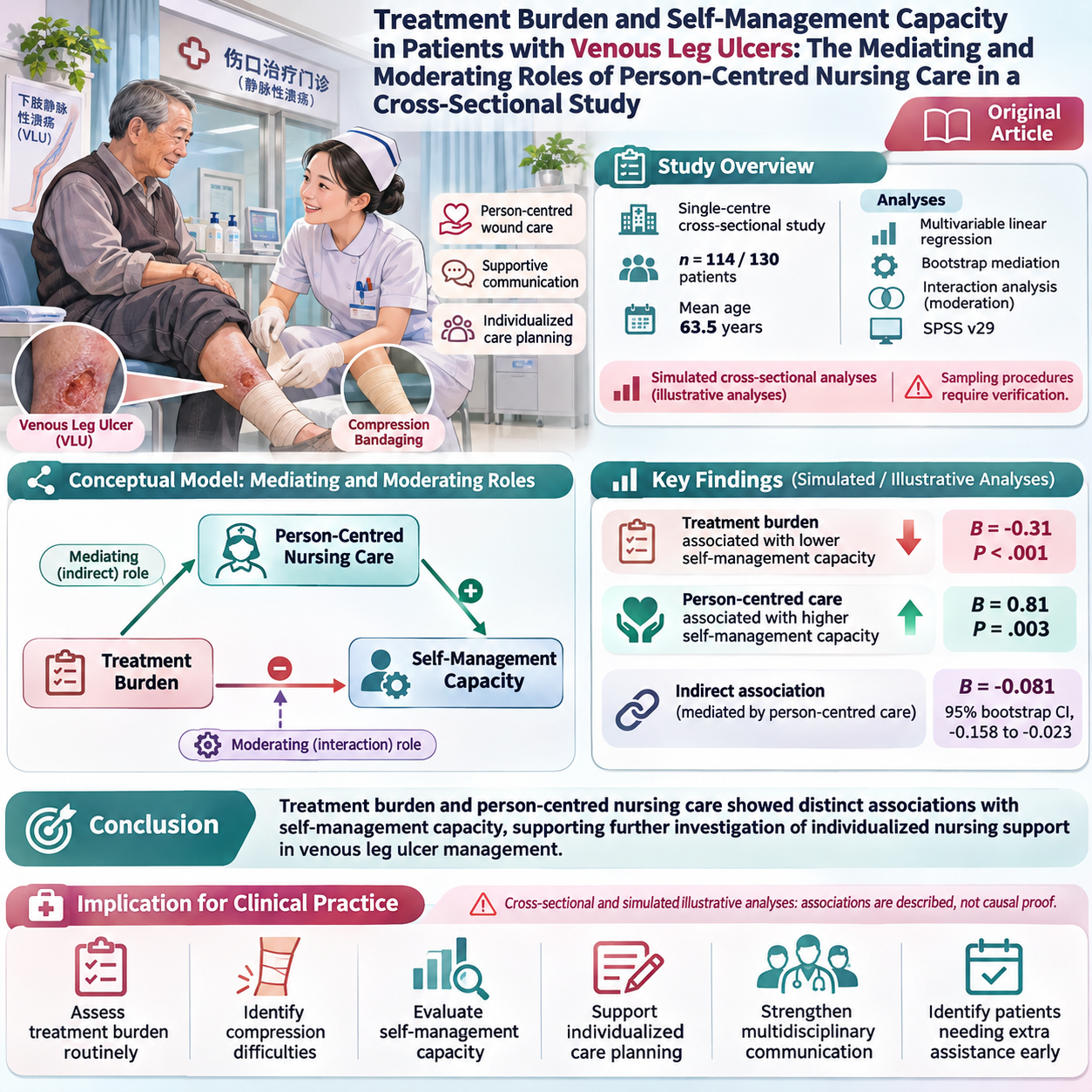
Approach: This single-centre cross-sectional study included 114 of 130 patients with venous leg ulcers. Illustrative analyses assumed adult eligibility and continuous questionnaire scores. Multivariable linear regression, bootstrap mediation, and interaction analyses were specified using SPSS version 29; sampling procedures require verification.
Results: In simulated analyses, participants' mean (SD) age was 63.5 (12.3) years. Greater treatment burden was associated with lower self-management capacity (B = −0.31; P < .001), while person-centred care showed a positive association (B = 0.81; P = .003). An indirect association was identified (B = −0.081; 95% bootstrap CI, −0.158 to −0.023).
Conclusions: Treatment burden and person-centred nursing care showed distinct associations with self-management capacity, supporting further investigation of individualized nursing support in venous leg ulcer management.
Implication for Clinical Practice: Routine assessment of treatment burden, compression difficulties, and self-management capacity may support individualized care planning, multidisciplinary communication, and timely identification of patients requiring additional assistance
Downloads
References
Burhan, A., Ali Khusein, N. B., & Sebayang, S. M. (2022). Effectiveness of negative pressure wound therapy on chronic wound healing: A systematic review and meta-analysis. Belitung Nursing Journal, 8(6), 470–480. DOI: 10.33546/bnj.2220.
Burhan, A., Susanti, I., Breu Da Silva, V. A., Kumar, V., Chi, D. T. K., Hidayat, R., Sebayang, S. M., & Hamka, H. (2025). Network meta-analysis of wound dressings and their effectiveness in promoting healing. Nurse Media Journal of Nursing, 15(2), 193–213. DOI: 10.14710/nmjn.v15i2.67063.
Duncan, P., Murphy, M., Man, M.-S., Chaplin, K., Gaunt, D., & Salisbury, C. (2018). Development and validation of the Multimorbidity Treatment Burden Questionnaire (MTBQ). BMJ Open, 8(4), e019413. DOI: 10.1136/bmjopen-2017-019413.
Duncan, P., Scott, L. J., Dawson, S., Munas, M., Pyne, Y., Chaplin, K., Gaunt, D., Guénette, L., & Salisbury, C. (2024). Further development and validation of the Multimorbidity Treatment Burden Questionnaire (MTBQ). BMJ Open, 14(4), e080096. DOI: 10.1136/bmjopen-2023-080096.
Johnsson, N., Fagerström, C., Lindberg, C., & Tuvesson, H. (2024). Supporting patients with venous leg ulcers in self-care monitoring: An interview study with primary health care professionals. Scandinavian Journal of Primary Health Care, 42(4), 515–524. DOI: 10.1080/02813432.2024.2346134.
Krizanova, O., Penesova, A., Hokynkova, A., Pokorna, A., Samadian, A., & Babula, P. (2024). Chronic venous insufficiency and venous leg ulcers: Aetiology, on the pathophysiology-based treatment. International Wound Journal, 21(2), e14405. DOI: 10.1111/iwj.14405.
McIntosh, E., Horspool, M., Levesley, M., Logan, P., & Klonizakis, M. (2023). The co-design of an exercise-based, lifestyle intervention for people with venous leg ulcers; A self-care, expert-supported strategy for a chronic condition. International Wound Journal, 20(7), 2528–2539. DOI: 10.1111/iwj.14117.
Perry, C., Atkinson, R. A., Griffiths, J., Wilson, P. M., Lavallée, J. F., Cullum, N., & Dumville, J. C. (2023). Barriers and facilitators to use of compression therapy by people with venous leg ulcers: A qualitative exploration. Journal of Advanced Nursing, 79(7), 2568–2584. DOI: 10.1111/jan.15608.
Probst, S., Saini, C., Gschwind, G., Stefanelli, A., Bobbink, P., Pugliese, M.-T., Cekic, S., Pastor, D., & Gethin, G. (2023). Prevalence and incidence of venous leg ulcers—A systematic review and meta-analysis. International Wound Journal, 20(9), 3906–3921. DOI: 10.1111/iwj.14272.
Rijken, M., Close, J., Menting, J., Lette, M., Stoop, A., Zonneveld, N., de Bruin, S. R., Lloyd, H., & Heijmans, M. (2022). Assessing the experience of person-centred coordinated care of people with chronic conditions in the Netherlands: Validation of the Dutch P3CEQ. Health Expectations, 25(3), 1069–1080. DOI: 10.1111/hex.13454.
Schick, R., Staub-Buset, C., Vujic, G., Lachappelle, S., & Panfil, E.-M. (2025). “I was surprised that the veins were the cause”—The illness trajectory of people with venous leg ulcers: A qualitative study. Journal of Tissue Viability, 34(1), 100837. DOI: 10.1016/j.jtv.2024.12.001.
Valesky, E. M., Hach-Wunderle, V., Protz, K., Zeiner, K. N., Erfurt-Berge, C., Goedecke, F., Jäger, B., Kahle, B., Kluess, H., Knestele, M., Kuntz, A., Lüdemann, C., Meissner, M., Mühlberg, K., Mühlberger, D., Pannier, F., Schmedt, C.-G., Schmitz-Rixen, T., Strölin, A., ... Dissemond, J. (2024). Diagnosis and treatment of venous leg ulcers: S2k guideline of the German Society of Phlebology and Lymphology (DGPL) e.V. Journal der Deutschen Dermatologischen Gesellschaft, 22(7), 1039–1051. DOI: 10.1111/ddg.15415.
von Elm, E., Altman, D. G., Egger, M., Pocock, S. J., Gøtzsche, P. C., & Vandenbroucke, J. P. (2007). The Strengthening the Reporting of Observational Studies in Epidemiology (STROBE) statement: Guidelines for reporting observational studies. The Lancet, 370(9596), 1453–1457. DOI: 10.1016/S0140-6736(07)61602-X.
Yildirim, J. G., & Lawn, S. (2025). Psychometric properties of the Turkish version of the Partners in Health Scale: Chronic disease self-management in primary healthcare. International Journal of Nursing Practice, 31(2), e70007. DOI: 10.1111/ijn.70007.
Downloads
Published
How to Cite
Issue
Section
License
Copyright (c) 2026 Luo Yunxi, Tan Songyun

This work is licensed under a Creative Commons Attribution-ShareAlike 4.0 International License.