
Nurse-Led Hybrid Self-Management Education Using Smartphone Alerts to Improve Foot Care Behavior and Wound Healing Risk Among Patients with Diabetic Foot Ulcers: A Randomized Clinical Trial
DOI:
https://doi.org/10.70196/jwrt.v3i1.89Keywords:
diabetic foot, health education, nursing care, patient compliance, self-management, smartphoneAbstract
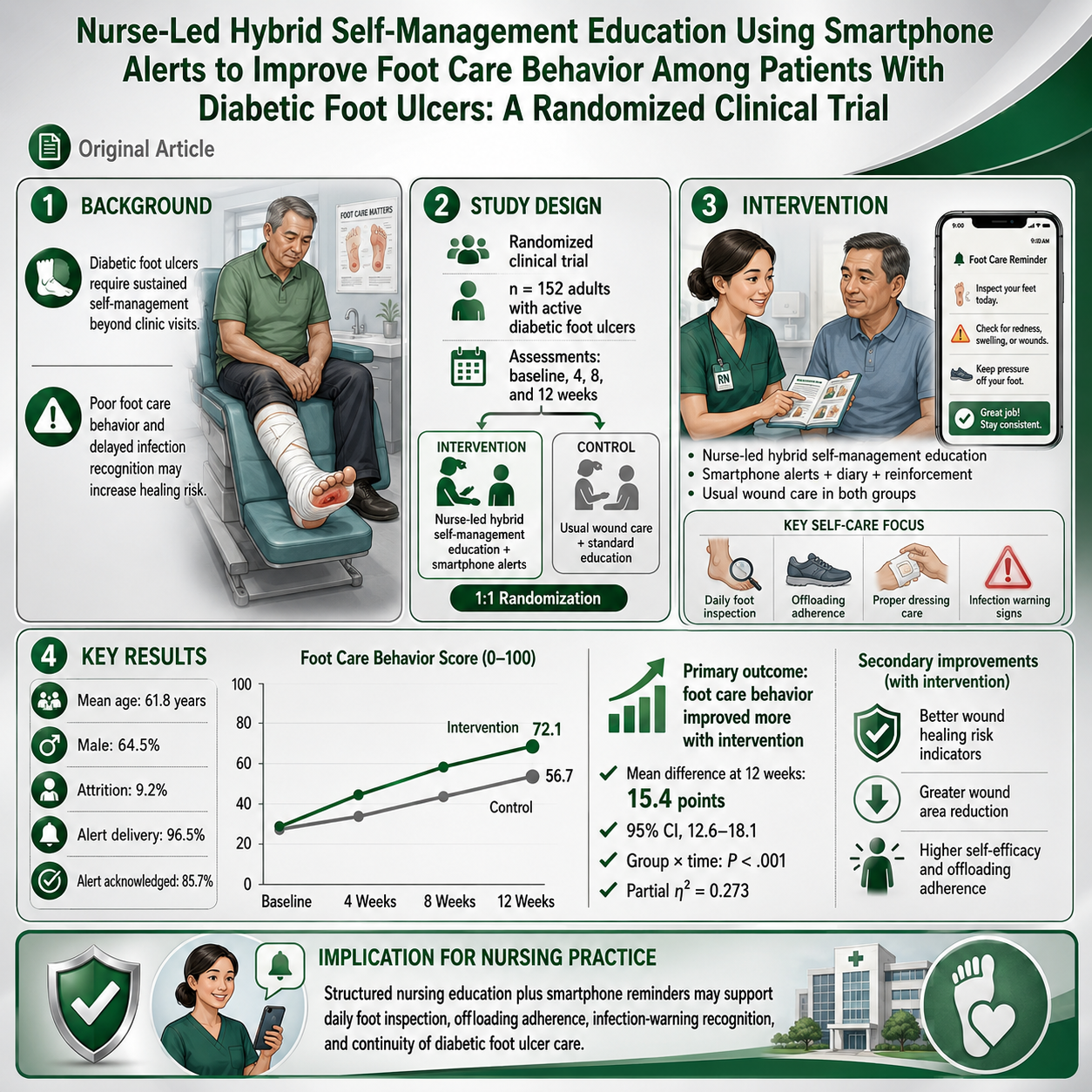
Background: Diabetic foot ulcers require sustained self-management beyond clinic visits. Poor foot care behavior, delayed recognition of infection, and inconsistent offloading adherence may increase wound healing risk and complicate nursing-led continuity of care.
Aim: To evaluate whether nurse-led hybrid self-management education using smartphone alerts improves foot care behavior in patients with diabetic foot ulcers
Approach: This randomized clinical trial enrolled 152 adults with active diabetic foot ulcers using consecutive recruitment at The Cootamundra Hospital. Eligible participants had diabetes, an active foot ulcer, smartphone access, and capacity for follow-up. Outcomes were measured at baseline, 4, 8, and 12 weeks using repeated-measures ANOVA
Results: Participants had a mean age of 61.8 years; 64.5% were male. Overall attrition was 9.2%. Smartphone alert delivery reached 96.5%, and 85.7% of delivered alerts were acknowledged. Foot care behavior improved more in the intervention group than in the control group at 12 weeks, with a mean between-group change difference of 15.4 points (95% CI, 12.6-18.1). The group × time interaction was significant, F(3, 408) = 50.97, P < .001, partial η² = 0.273
Conclusions: Nurse-led hybrid self-management education supported by smartphone alerts was associated with greater improvement in foot care behavior among patients with diabetic foot ulcers
Implication for Nursing Practice: Structured nursing education combined with smartphone reminders may support daily foot inspection, offloading adherence, infection-warning recognition, and continuity of diabetic foot ulcer care
Downloads
References
Alawadhi, A., Khan, K. S., Messenger, G., Cusworth, A., Assi, M., Gray, S. R., & Al-Ozairi, E. (2026). Long-term effects of multimedia education and “foot alerts” through the MyU app on diabetic foot care in individuals with moderate-high risk: Pilot randomized controlled trial. JMIR Human Factors, 13, e78261. doi: 10.2196/78261
Bandura, A. (1977). Self-efficacy: Toward a unifying theory of behavioral change. Psychological Review, 84(2), 191–215. doi: 10.1037/0033-295X.84.2.191
Bus, S. A., Sacco, I. C. N., Monteiro-Soares, M., Raspovic, A., Paton, J., Rasmussen, A., Lavery, L. A., & van Netten, J. J. (2024). Guidelines on the prevention of foot ulcers in persons with diabetes: IWGDF 2023 update. Diabetes/Metabolism Research and Reviews, 40(3), e3651. doi: 10.1002/dmrr.3651
Chan, A.-W., Boutron, I., Hopewell, S., Moher, D., Schulz, K. F., Collins, G. S., & SPIRIT Group. (2025). SPIRIT 2025 statement: Updated guideline for protocols of randomized trials. JAMA. doi: 10.1001/jama.2025.4486
Çelik Polat, E., Arıkan Dönmez, A., & Çakal, E. (2026). A nurse-led self-efficacy–based hybrid diabetic foot self-management education program for individuals with diabetes: A randomized controlled trial. BMC Nursing, 25, 233. doi: 10.1186/s12912-026-04396-3
de Souza Santos, G., Oliveira, R. S. S., Rodrigues, Y. B., Lima, E. S., & Carvalho, D. R. (2025). Global burden of diabetic foot ulcers: A systematic review on prevalence, mortality, and clinical-economic impact. Research, Society and Development, 14(7), e3914749222. doi: 10.33448/rsd-v14i7.49222
Hopewell, S., Chan, A.-W., Collins, G. S., Hróbjartsson, A., Moher, D., Schulz, K. F., & CONSORT Group. (2025). CONSORT 2025 statement: Updated guideline for reporting randomized trials. JAMA. doi: 10.1001/jama.2025.4347
Méndez, N. G., Aguilera, M. F. G., Muñoz, E. Á., Rivadeneira, J., Cabrera, P. J. B., Totomoch-Serra, A., Romo, P. L., Aguilar, P. V., Cid, M. A. E., & Díaz, M. A. P. (2025). New technologies applied in self-care to patients with diabetic foot ulcers: A scoping review. Diabetology & Metabolic Syndrome, 17, 262. doi: 10.1186/s13098-025-01822-5
Navarro-Flores, E., Morales-Asencio, J. M., Cervera-Marín, J. A., Labajos-Manzanares, M. T., & Gijón-Noguerón, G. (2015). Development, validation and psychometric analysis of the diabetic foot self-care questionnaire of the University of Malaga, Spain (DFSQ-UMA). Journal of Tissue Viability, 24(1), 24–34. doi: 10.1016/j.jtv.2014.11.001
Ruiz-Muñoz, M., Fernández-Torres, R.,
Downloads
Published
How to Cite
Issue
Section
License
Copyright (c) 2026 Victor Maxwel, Michael Grabrilia, Alexa Barbates, William Jack Isla

This work is licensed under a Creative Commons Attribution-ShareAlike 4.0 International License.