
Nutritional Risk, Frailty, and Inflammatory Biomarkers as Correlates of Infection Severity and Healing Risk in Patients with Diabetic Foot Ulcers: A Hospital-Based Cross-Sectional Study
DOI:
https://doi.org/10.70196/jwrt.v3i1.88Keywords:
c-reactive protein, diabetic foot, frailty, inflammation mediators, malnutrition, wound healingAbstract
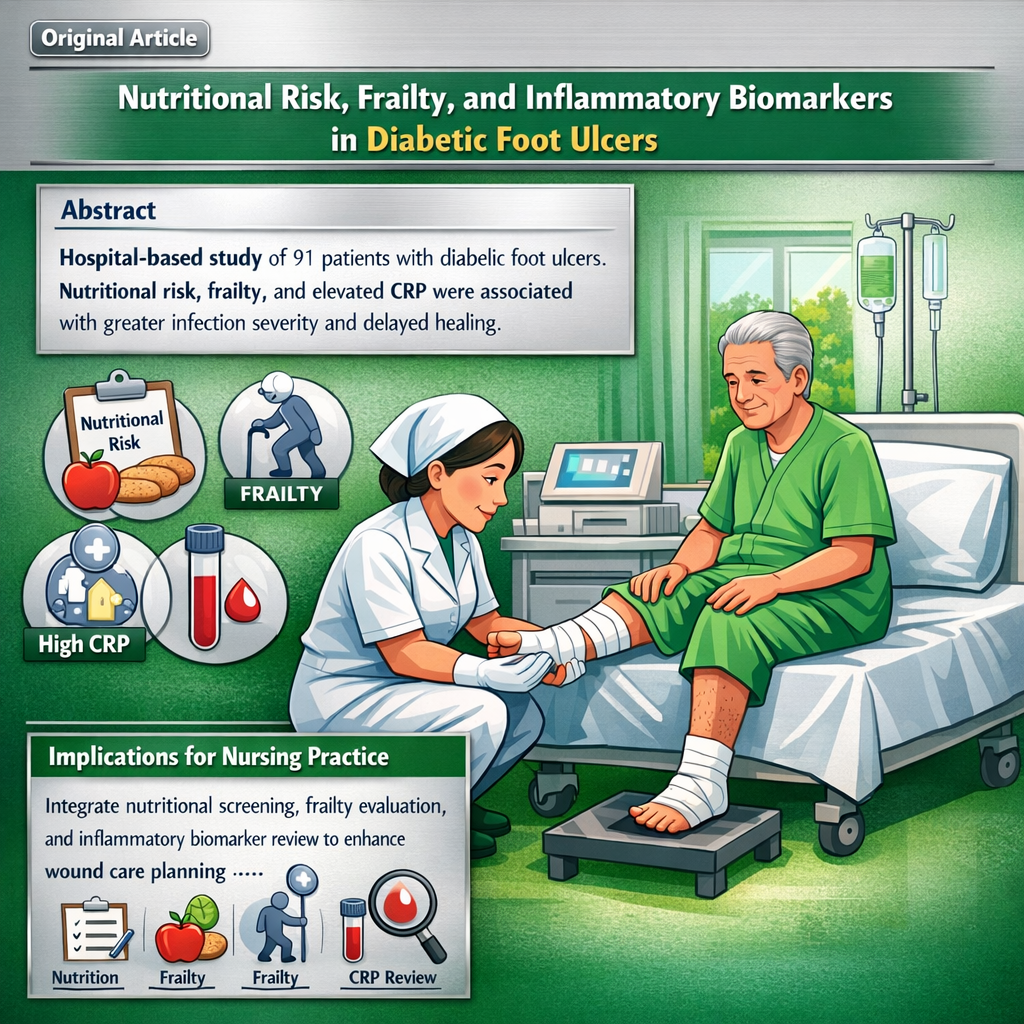
Background: Diabetic foot ulcers (DFU) remain a major clinical problem because severe infection and poor healing increase hospitalization, amputation, and mortality. Patient-level factors such as nutritional vulnerability, frailty, and inflammatory burden may be clinically relevant, but integrated hospital-based evidence remains limited, particularly in Indonesian wound-care settings.
Aim: To examine whether nutritional risk, frailty, and inflammatory biomarkers were associated with infection severity and healing risk in hospitalized patients with diabetic foot ulcers.
Approach: This hospital-based cross-sectional study included 91 adults with active diabetic foot ulcers at General Hospital Bhakti Rahayu. Consecutive sampling was used. Eligible participants had diabetes, an active ulcer, and complete clinical and laboratory data. Ordinal and binary logistic regression analyses were performed using IBM SPSS Statistics version 19
Results: The mean (SD) age was 58.6 (10.9) years, 62.6% were male, 73.6% had nutritional risk, and 41.8% were frail. Infection severity was mild in 31.9%, moderate in 47.3%, and severe in 20.9%. Higher infection severity was associated with nutritional risk (aOR, 3.18; 95% CI, 1.05-9.67; P = .04), frailty (aOR, 2.24; 95% CI, 1.01-4.98; P = .048), and higher CRP per 10-mg/L increase (aOR, 1.22; 95% CI, 1.05-1.42; P = .01)
Conclusions: Nutritional risk, frailty, and inflammatory burden were associated with greater infection severity in hospitalized patients with diabetic foot ulcers.
Implication for Nursing Practice: Nursing assessment of diabetic foot ulcers may benefit from integrating nutritional screening, frailty evaluation, and inflammatory biomarker review to support earlier risk identification and more individualized wound-care planning.
Downloads
References
Armstrong, D. G., Tan, T.-W., Boulton, A. J. M., & Bus, S. A. (2023). Diabetic foot ulcers: A review. JAMA, 330(1), 62–75. doi:10.1001/jama.2023.10578
Bilici, D., & Kılıç, M. (2026). Impact of frailty on foot care behaviors and self-efficacy in middle-aged and older adults with type 2 diabetes. Primary Care Diabetes, 20(1), 115–119. doi:10.1016/j.pcd.2025.11.009
Burhan, A., Cruz, M. A. D., Ling, G. T. W., Susanti, I., Kittisak, N., Firdaus, E. K., & Sebayang, S. M. (2025). Amputation-free survival and time-to-healing in diabetic foot ulcers: A multistate competing-risks survival analysis. Journal of Wound Research and Technology, 2(2), 72–80. doi:10.70196/jwrt.v2i2.69
Burhan, A., Khusein, N. bin A., & Sebayang, S. M. (2022). Effectiveness of negative pressure wound therapy on chronic wound healing: A systematic review and meta-analysis. Belitung Nursing Journal, 8(6), 470–480. doi:10.33546/bnj.2220
Burhan, A., Susanti, I., Breu Da Silva, V. A., Kumar, V., Chi, D. T. K., Hidayat, R., Sebayang, S. M., & Hamka, H. (2025). Network meta-analysis of wound dressings and their effectiveness in promoting healing. Nurse Media Journal of Nursing, 15(2), 193–213. doi:10.14710/nmjn.v15i2.67063
Burhan, A., Syafiqah, N., Ruangdet, K., MacLeod, R., Roy, A. D., Norrström, E. M., & Susanti, I. (2025). Hidden wounds: Prevalence of chronic wounds in Asia, a systematic review and meta-analysis. Java Nursing Journal, 3(3), 221–235. doi:10.61716/jnj.v3i3.117
Canpolat-Erkan, R. E., Tekin, R., & Ekinci, A. (2026). Evaluation of neutrophil-to-lymphocyte ratio and CRP-to-albumin ratio in the risk stratification of diabetic foot infection severity. Medicina, 62(2), 393. doi:10.3390/medicina62020393
Chen, L., Sun, S., Gao, Y., & Ran, X. (2023). Global mortality of diabetic foot ulcer: A systematic review and meta-analysis of observational studies. Diabetes, Obesity and Metabolism, 25(1), 36–45. doi:10.1111/dom.14840
Haruka, K., Burhan, A., Nanami, I., & Kento, F. (2025). Trajectories of transcutaneous oxygen (TcPO2) and healing in chronic limb-threatening ischemia: A 12-month longitudinal study. Journal of Wound Research and Technology, 2(2), 54–63. doi:10.70196/jwrt.v2i2.67
Huang, E. Y. Z., Cheung, J., Liu, J. Y. W., Kwan, R. Y. C., & Lam, S. C. (2022). Groningen Frailty Indicator–Chinese (GFI-C) for pre-frailty and frailty assessment among older people living in communities: Psychometric properties and diagnostic accuracy. BMC Geriatrics, 22, 788. doi:10.1186/s12877-022-03437-1
Jeffcoate, W., Boyko, E. J., Game, F., Cowled, P., Senneville, E., & Fitridge, R. (2024). Causes, prevention, and management of diabetes-related foot ulcers. The Lancet Diabetes & Endocrinology, 12(7), 472–482. doi:10.1016/S2213-8587(24)00110-4
Jiao, Y., Wang, S., Si, R., Xiao, J., Yin, Y., & Yan, D. (2025). Association between frailty and diabetic foot ulceration: A cross-sectional analysis of NHANES data. The International Journal of Lower Extremity Wounds. Advance online publication. doi:10.1177/15347346251394634
Kunda, H. C., Yadav, M. A., Kalpana, T. S. R., Patel, D. P., Sivanoli, S., Shah, N. D., Shahista, S., & Panchal, J. (2025). Clinical evaluation of diabetic foot ulcers using the SINBAD (Site, Ischemia, Neuropathy, Bacterial Infection, Area, and Depth) scoring system: A prospective study. Cureus, 17(7), e89044. doi:10.7759/cureus.89044
Lauwers, P., Dirinck, E., Van Bouwel, S., Verrijken, A., Van Dessel, K., Van Gils, C., Sels, M., Peiffer, F., Van Schil, P., De Block, C., & Hendriks, J. (2022). Malnutrition and its relation with diabetic foot ulcer severity and outcome: A review. Acta Clinica Belgica, 77(1), 79–85. doi:10.1080/17843286.2020.1800315
Lim, Q.-H., Loy, L. C.-W., Abdul Hadi, H., Faheem, N. A. N., Shaharuddin, I. S., Ponnampalavanar, S. S. L., & Lim, L.-L. (2025). Diabetic foot ulcer in the Western Pacific Region: Current data on ulceration rates and microbial profiles, gaps and charting strategies. Primary Care Diabetes, 19(2), 133–142. doi:10.1016/j.pcd.2024.12.012
Mahendra, R. E. F., Burhan, A., & Susanti, I. (2024). An analysis of various wound washing methods and their efficacy in treating chronic wounds: A comprehensive review of existing literature. Journal of Wound Research and Technology, 1(1), 1–7. doi:10.70196/jwrt.v1i1.2
Midao, L., Duarte, M., Sampaio, R., Almada, M., Dias, C. C., Paúl, C., & Costa, E. (2025). FRAILSURVEY—an mHealth app for self-assessment of frailty based on the Portuguese version of the Groningen Frailty Indicator: Validation and reliability study. JMIR Formative Research, 9, e51975. doi:10.2196/51975
Muharram, F. R., Swannjo, J. B., Melbiarta, R. R., & Martini, S. (2025). Trends of diabetes and pre-diabetes in Indonesia 2013–2023: A serial analysis of national health surveys. BMJ Open, 15(9), e098575. doi:10.1136/bmjopen-2024-098575
Neal, L., Yates, T., Shabnam, S., McCarthy, M., Dempsey, P. C., Davies, M., Khunti, K., & Zaccardi, F. (2026). Frailty, diabetic foot ulceration and mortality in people diagnosed with type 2 diabetes: Multistate analysis of primary care patients in the UK clinical practice research datalink. Diabetes Research and Clinical Practice, 231, 113058. doi:10.1016/j.diabres.2025.113058
Ran, Q., Xu, W., Zhao, X., Sun, H., Liu, L., & Luo, Y. (2024). Risk factors for malnutrition in patients with diabetic foot ulcer and its association with prolonged length of hospitalization. Nutrition & Diabetes, 14, 26. doi:10.1038/s41387-024-00290-6
Ran, Q., Zhao, X., Xu, W., Liu, L., Sun, H., & Luo, Y. (2025). Consistency of Mini-Nutritional Assessment short form and Nutritional Risk Screening 2002 in nutritional evaluation of diabetic foot patients. Frontiers in Nutrition, 12, 1596193. doi:10.3389/fnut.2025.1596193
Romano, G., More, C., Garnier, É., Fernández Navarro, L., & Burhan, A. (2025). A clean fight: Comparing metronidazole and silver sulfadiazine gels in treating infected diabetic foot ulcers: A randomized control trial. Java Nursing Journal, 3(3), 276–286. doi:10.61716/jnj.v3i3.115
Schaper, N. C., van Netten, J. J., Apelqvist, J., Bus, S. A., Fitridge, R., Game, F., Monteiro-Soares, M., Senneville, E., & IWGDF Editorial Board. (2024). Practical guidelines on the prevention and management of diabetes-related foot disease (IWGDF 2023 update). Diabetes/Metabolism Research and Reviews, 40(3), e3657. doi:10.1002/dmrr.3657
Senneville, É., Albalawi, Z., van Asten, S. A., Abbas, Z. G., Allison, G., Aragón-Sánchez, J., Embil, J. M., Lavery, L. A., Alhasan, M., Oz, O., Uçkay, I., Urbančič-Rovan, V., Xu, Z.-R., & Peters, E. J. G. (2024). IWGDF/IDSA guidelines on the diagnosis and treatment of diabetes-related foot infections (IWGDF/IDSA 2023). Diabetes/Metabolism Research and Reviews, 40(3), e3687. doi:10.1002/dmrr.3687
Srisawat, S., Kittipong, N., Pimchanok, R., Hassan, A. binti, Salleh, S. binti, Susanti, I., & Burhan, A. (2025). Efficacy of bioactive dressings compared to passive dressings in promoting wound healing in diabetic foot ulcers: A randomized controlled trial. Journal of Wound Research and Technology, 2(1), 19–27. doi:10.70196/jwrt.v2i1.43
von Elm, E., Altman, D. G., Egger, M., Pocock, S. J., Gøtzsche, P. C., & Vandenbroucke, J. P. (2007). The Strengthening the Reporting of Observational Studies in Epidemiology (STROBE) statement: Guidelines for reporting observational studies. PLoS Medicine, 4(10), e296. doi:10.1371/journal.pmed.0040296
Wang, Y.-T., Zhang, L.-X., Li, Y., Zhao, J., & Chen, H.-L. (2023). Inflammatory markers in diabetic foot infection: A meta-analysis. Wounds, 35(12), 425–432. doi:10.25270/wnds/082421.03
Downloads
Published
How to Cite
Issue
Section
License
Copyright (c) 2026 Samsul Adipati, Akbar Faruk , Asmat Burhan

This work is licensed under a Creative Commons Attribution-ShareAlike 4.0 International License.