Frailty, Comorbidity, and Functional Limitation Among Older Adults with Venous Leg Ulcers: A Cross-Sectional Study
Keywords:
activities of daily living, aged, comorbidity, frailty, leg ulcer, venous insufficiencyAbstract
Background: Venous leg ulcers in older adults are frequently accompanied by frailty, multimorbidity, and reduced physical independence, yet evidence on their combined relationship remains limited, particularly in Indonesian clinical settings.
Aim: To examine frailty, comorbidity, and functional limitation among older adults with venous leg ulcers
Approach: This cross-sectional study included 118 older adults with venous leg ulcers assessed between June 23 and August 1, 2022, using consecutive sampling. Eligible participants were aged 60 years or older with clinician-diagnosed venous leg ulcers. Frailty, comorbidity, and functional limitation were measured using validated instruments. Data were analyzed using multivariable linear regression
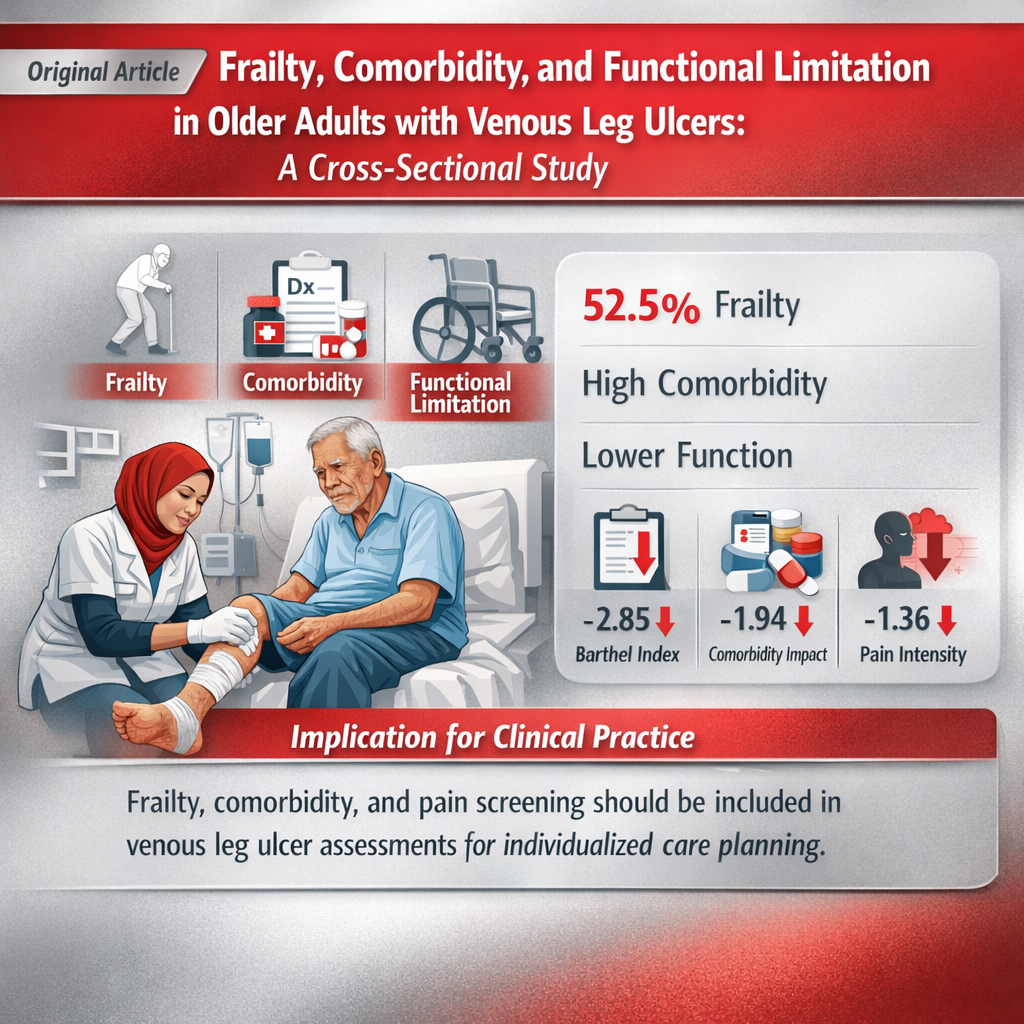
Results: A total of 118 patients completed the study. Results showed that the mean (SD) age was 69.8 (7.1) years, 71 participants (60.2%) were women, and the mean (SD) Barthel Index score was 72.4 (16.8). Frailty was present in 62 participants (52.5%). In the adjusted model, higher frailty score was associated with lower Barthel Index score (β = -2.85; 95% CI, -3.98 to -1.72; P < .001), as were higher comorbidity burden (β = -1.94; 95% CI, -3.29 to -0.59; P = .005) and greater pain intensity (β = -1.36; 95% CI, -2.28 to -0.44; P = .004)
Conclusions: Functional limitation was common among older adults with venous leg ulcers and was associated with frailty, comorbidity burden, and pain intensity
Implication for Clinical Practice: Routine venous leg ulcer assessment in older adults may benefit from brief screening for frailty, comorbidity, and pain to support risk identification, individualized care planning, and function-oriented wound management.
References
Barros, V. dos S., da Silva, J. M., Netto, J. J. M., de Oliveira, B. G. R. B., Andrade, M. S., & Peres, M. F. T. (2022). Barthel Index is a valid and reliable tool to measure the functional independence of cancer patients in palliative care. BMC Palliative Care, 21(1), 124. DOI: 10.1186/s12904-022-01017-z
Bjelkarøy, M. T., Benth, J. Š., Simonsen, T. B., Siddiqui, T. G., Cheng, S., Kristoffersen, E. S., & Lundqvist, C. (2024). Measuring pain intensity in older adults: Can the visual analogue scale and the numeric rating scale be used interchangeably? Progress in Neuro-Psychopharmacology & Biological Psychiatry, 130, 110925. DOI: 10.1016/j.pnpbp.2023.110925
Chu, L., Etkin, Y., Dowling, C., & Oropallo, A. (2025). Assessment and management of chronic venous, arterial, and diabetic wounds in older adults. Seminars in Vascular Surgery, 38(3), 281–290. DOI: 10.1053/j.semvascsurg.2025.06.007
Duluklu, B., Ivory, J., McElvaney, A., Bligh, A., Cahill-Collins, M., Gethin, G., Liew, A., & Sezgin, D. (2025). Frailty and comorbidity in older adults with and without diabetes and chronic leg ulcer: A cross-sectional study. International Wound Journal, 22(1), e70119. DOI: 10.1111/iwj.70119
Faul, F., Erdfelder, E., Buchner, A., & Lang, A.-G. (2009). Statistical power analyses using G*Power 3.1: Tests for correlation and regression analyses. Behavior Research Methods, 41(4), 1149–1160. DOI: 10.3758/BRM.41.4.1149
Folguera-Álvarez, C., Garrido-Elustondo, S., Rico-Blázquez, M., & Verdú-Soriano, J. (2022). Factors associated with the quality of life of patients with venous leg ulcers in primary care: Cross-sectional study. The International Journal of Lower Extremity Wounds, 21(4), 521–528. DOI: 10.1177/1534734620967562
Gethin, G., Vellinga, A., Tawfick, W., O’Loughlin, A., McIntosh, C., Mac Gilchrist, C., Murphy, L., Ejiugwo, M., O’Regan, M., Cameron, A., & Ivory, J. D. (2021). The profile of patients with venous leg ulcers: A systematic review and global perspective. Journal of Tissue Viability, 30(1), 78–88. DOI: 10.1016/j.jtv.2020.08.003
Graves, N., Ganesan, G., Tan, K. B., Goh, O. Q. M., Ho, J., Chong, T. T., Bishnoi, P., Carmody, D., Yuh, A. S., Ng, Y. Z., Lo, Z., Enming, Y., Aloweni, F. A. B., Zifei, W., & Harding, K. (2023). Chronic wounds in a multiethnic Asian population: A cost of illness study. BMJ Open, 13(9), e065692. DOI: 10.1136/bmjopen-2022-065692
Huang, E. Y. Z., Cheung, J., Liu, J. Y. W., Kwan, R. Y. C., & Lam, S. C. (2022). Groningen Frailty Indicator–Chinese (GFI-C) for pre-frailty and frailty assessment among older people living in communities: Psychometric properties and diagnostic accuracy. BMC Geriatrics, 22(1), 788. DOI: 10.1186/s12877-022-03437-1
Mayrovitz, H. N., Wong, S., & Mancuso, C. (2023). Venous, arterial, and neuropathic leg ulcers with emphasis on the geriatric population. Cureus, 15(4), e38123. DOI: 10.7759/cureus.38123
McDaniel, J. C., Kim, B., McGowan, D. R., & Tan, A. (2025). Factors associated with quality of life in patients with venous leg ulcers in a community setting: A cross-sectional study. Health Science Reports, 8(11), e71441. DOI: 10.1002/hsr2.71441
Nimmaanrat, S., Thepsuwan, A., Tipchatyotin, S., Junpee, A., & Phinkhian, S. (2024). Measuring pain intensity in older patients: A comparison of five scales. BMC Geriatrics, 24(1), 556. DOI: 10.1186/s12877-024-05127-6
Probst, S., Saini, C., Gschwind, G., Stefanelli, A., Bobbink, P., Pugliese, M.-T., Cekic, S., Pastor, D., & Gethin, G. (2023). Prevalence and incidence of venous leg ulcers: A systematic review and meta-analysis. International Wound Journal, 20(9), 3906–3921. DOI: 10.1111/iwj.14272
Puspita Sari, L. G. M., & Suryawati, N. (2023). Characteristics of lower extremity ulcers among patients treated at Prof. Dr. I.G.N.G. Ngoerah General Hospital, Denpasar, Bali. Journal of the Medical Sciences (Berkala Ilmu Kedokteran), 55(4).* DOI: 10.19106/JMedSci005504202302
Raffetto, J. D., Ligi, D., Maniscalco, R., Khalil, R. A., & Mannello, F. (2021). Why venous leg ulcers have difficulty healing: Overview on pathophysiology, clinical consequences, and treatment. Journal of Clinical Medicine, 10(1), 29. DOI: 10.3390/jcm10010029
Sato, R., Taniguchi, Y., Watanabe, Y., Nofuji, Y., & Murayama, H. (2026). Declines in activities in daily living of older adults with sarcopenia were associated with gait speed. Medicina, 62(2), 263. DOI: 10.3390/medicina62020263
Shin, D. W., & Han, K. (2025). The use of Charlson comorbidity index for observational studies using administrative data in Korea. Precision and Future Medicine, 9(1), 2–14. DOI: 10.23838/pfm.2024.00191
Siegling, M., Härtel, G., Ruegsegger, M., Weibel, L., Hug, K., Stoyanov, J., Sutter, F., & Läuchli, S. (2023). Mobility range, level of pain and sleep quality of patients with venous leg ulcers. International Wound Journal, 20(8), 3177–3184. DOI: 10.1111/iwj.14195
Zhang, J., Zhou, M., Liu, A., Ye, R., & Wang, Y. (2026). Determining optimal Barthel Index cutoff scores for predicting Longshi Scale grades across age groups in stroke patients. Frontiers in Aging, 7, 1701910. DOI: 10.3389/fragi.2026.1701910
Zorge, N. E., van Asten, S. A. V., Nikolaou, V., Ulrich, M., Hoeksema, H., Kannan, A., Papp, A., Probst, S., Stingl, D., Vuerstaek, J. D. D., & van Hecke, A. (2023). A prospective, multicentre study to assess frailty in elderly patients with leg ulcers (GERAS study). Journal of the European Academy of Dermatology and Venereology, 37(2), 428–435. DOI: 10.1111/jdv.18586
Downloads
Published
How to Cite
Issue
Section
License
Copyright (c) 2026 Asmat Burhan, Rahmad Effan Farhri Mahendra, Firman Rosadi

This work is licensed under a Creative Commons Attribution-ShareAlike 4.0 International License.