Factors Associated with Peripheral Arterial Ulcer Severity and Healing Risk: A Cross-Sectional Study
Keywords:
ankle-brachial index, peripheral arterial disease, podiatry, risk factors, wound healing, wounds and injuriesAbstract
Background: Peripheral arterial ulcer severity remains a major wound-care challenge because it is closely linked to ischemia, infection, delayed healing, and increased limb threat, particularly in outpatient podiatry practice, where early risk stratification and multidimensional assessment are often needed.
Aim: To identify factors associated with peripheral arterial ulcer severity and healing risk in an outpatient podiatry population
Approach: This cross-sectional study included 76 adults selected by consecutive sampling between October 23 and October 30, 2025. Eligible participants had active peripheral arterial ulcers and complete clinical assessment data. Outcomes were wound severity and healing risk. Data were analyzed using descriptive statistics, simple linear regression, multivariable linear regression, and exploratory mediation analysis.
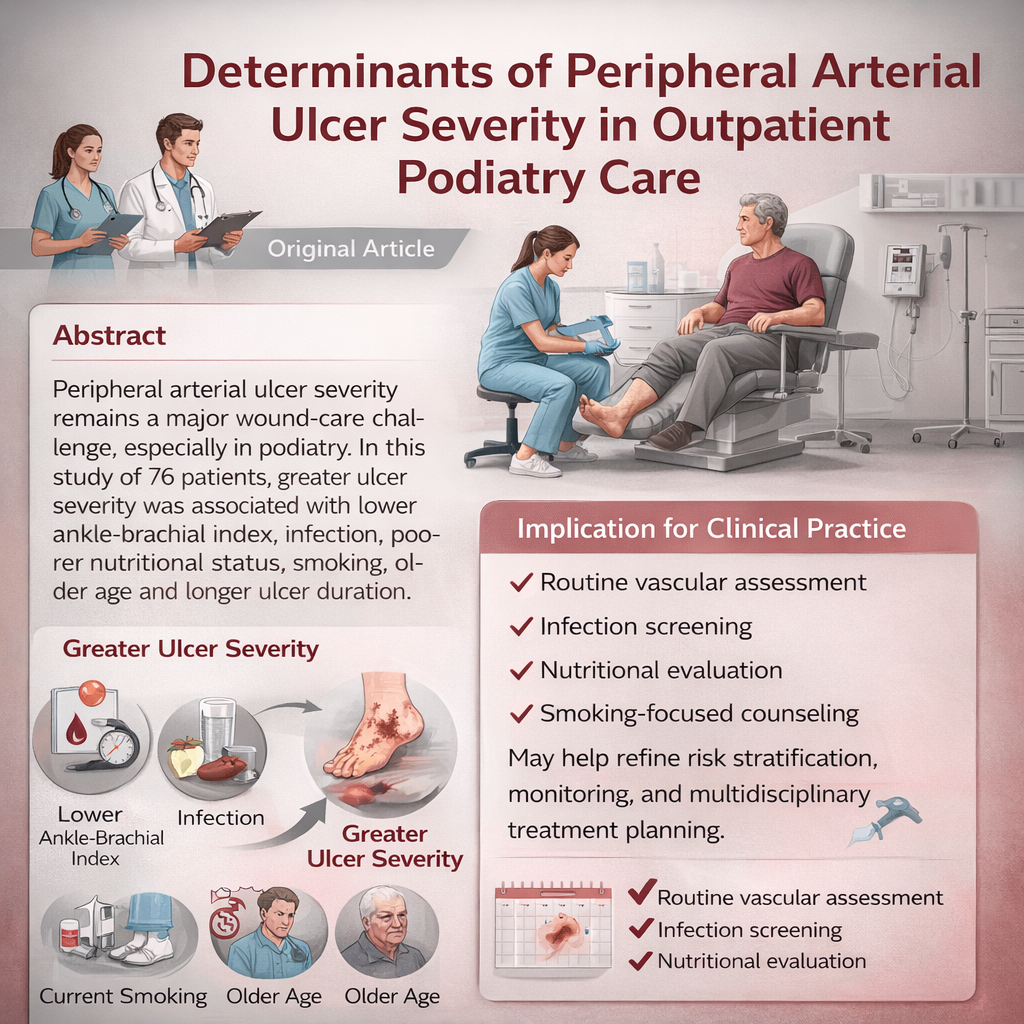
Results: Total patients who completed the study was 76. The mean (SD) age was 61.8 (10.7) years, 46 patients (60.5%) were male, and the mean (SD) BWAT severity score was 31.4 (8.2). Results showed that lower ankle-brachial index, current smoking, longer ulcer duration, poorer nutritional status, and clinical infection were associated with higher wound severity in unadjusted analysis. In the adjusted model, infection (B, 4.82; 95% CI, 2.01 to 7.63; P = .001), lower ankle-brachial index (B, -6.14; 95% CI, -9.88 to -2.40; P = .002), poorer nutritional status (B, -0.71; 95% CI, -1.18 to -0.24; P = .004), smoking (B, 2.96; 95% CI, 0.58 to 5.34; P = .02), older age (B, 0.12; 95% CI, 0.01 to 0.23; P = .03), and longer ulcer duration (B, 0.09; 95% CI, 0.02 to 0.16; P = .01) remained associated with greater severity.
Conclusions: Peripheral arterial ulcer severity was associated with impaired perfusion, infection, nutritional vulnerability, smoking, age, and ulcer chronicity in outpatient podiatry care.
Implication for Nursing Practice: Routine vascular assessment, infection screening, nutritional evaluation, and smoking-focused counseling may help refine risk stratification, monitoring, and multidisciplinary treatment planning for patients with peripheral arterial ulcers.
References
Armstrong, D. G., Tan, T.-W., Boulton, A. J. M., & Bus, S. A. (2023). Diabetic foot ulcers: A review. JAMA, 330(1), 62–75. doi:10.1001/jama.2023.10578
Bates-Jensen, B. M., McCreath, H. E., Harputlu, D., & Patlan, A. (2019). Reliability of the Bates-Jensen Wound Assessment Tool for pressure injury assessment: The pressure ulcer detection study. Wound Repair and Regeneration, 27(4), 386–395. doi:10.1111/wrr.12714
Cerqueira, M. M. B. da F., de Barros, A. L., de Oliveira, A. L. C. B., Nogueira, J. A. D., Costa, M. M., de Alencar, M. C. N., & Costa, I. K. F. (2024). Accuracy of ankle-brachial index in screening for peripheral arterial disease in people with diabetes. PLOS ONE, 19(10), e0309083. doi:10.1371/journal.pone.0309083
Chuter, V., Schaper, N., Hinchliffe, R., Mills, J., Azuma, N., Behrendt, C.-A., Boyko, E. J., Conte, M. S., Humphries, M., Kirksey, L., McGinigle, K. C., Nikol, S., Nordanstig, J., Rowe, V., David, R., van den Berg, J. C., Venermo, M., & Fitridge, R. (2024). Performance of non-invasive bedside vascular testing in the prediction of wound healing or amputation among people with foot ulcers in diabetes: A systematic review. Diabetes/Metabolism Research and Reviews, 40(3), e3701. doi:10.1002/dmrr.3701
Cook, I. O., Mayor, J. M., & Mills, J. L., Sr. (2024). A review of WIfI clinical staging to predict outcomes in patients with threatened limbs. Annals of Vascular Surgery, 107, 146–153. doi:10.1016/j.avsg.2024.01.024
Faul, F., Erdfelder, E., Buchner, A., & Lang, A.-G. (2009). Statistical power analyses using G*Power 3.1: Tests for correlation and regression analyses. Behavior Research Methods, 41(4), 1149–1160. doi:10.3758/BRM.41.4.1149
Fu, M., & Zhang, H. (2025). Global burden of peripheral arterial disease and its risk factors, 1990–2021. BMC Cardiovascular Disorders, 25(1), 631. doi:10.1186/s12872-025-05055-2
Georgeson, A. R., Alvarez-Bartolo, D., & MacKinnon, D. P. (2025). A sensitivity analysis for temporal bias in cross-sectional mediation. Psychological Methods, 30(6), 1326–1344. doi:10.1037/met0000628
Gornik, H. L., Gerhard-Herman, M., Criqui, M. H., Aboyans, V., Armstrong, E. J., Aronow, H. D., Fitridge, R., Hamburg, N. M., Kinlay, S., Lookstein, R. A., Misra, S., Mohler, E. R., Olin, J. W., Patel, R. A., Pradhan, A. D., Rockman, C. B., Rosenfield, K., Shishehbor, M. H., Stanley, J. C., … Writing Committee. (2024). 2024 ACC/AHA/AACVPR/APMA/ABC/SCAI/SVM/SVN/SVS/SIR/VESS guideline for the management of lower extremity peripheral artery disease. Circulation, 150(24), e1313–e1410. doi:10.1161/CIR.0000000000001251
Gould, L. J., Iyengar, S., Heerspink, D., Best, S., Jinnette, M., Patel, M., Mahoney, D. W., & Nigwekar, S. U. (2021). Development of the BWAT-CUA scale to assess wounds in patients with calciphylaxis. Diagnostics, 11(4), 730. doi:10.3390/diagnostics11040730
Grada, A., & Phillips, T. J. (2022). Nutrition and cutaneous wound healing. Clinics in Dermatology, 40(2), 103–113. doi:10.1016/j.clindermatol.2021.10.002
Hidayat, U. R., Arisandi, D., Alfikrie, F., & Hatmalyakin, D. (2025). C-reactive protein as an independent predictor of diabetic foot ulcer healing in Indonesia: A prospective study. The Diabetic Foot Journal, 28(1), 67–71. DOI not available in the indexed source I could verify.
International Diabetes Federation. (2025). IDF Diabetes Atlas (11th ed.). International Diabetes Federation. DOI not available.
Kaluźniak-Szymanowska, A., Deskur-Śmielecka, E., Krzymińska-Siemaszko, R., Styszyński, A., Tobis, S., Lewandowicz-Czarnecka, M., Chudek, J., Kostka, T., Mossakowska, M., Piotrowicz, K., Kujawska-Danecka, H., & Wieczorowska-Tobis, K. (2025). Diagnostic performance of mini nutritional assessment-short form against the global leadership initiative on malnutrition criteria. Scientific Reports, 15(1), 45621. doi:10.1038/s41598-025-30004-6
Lim, Q.-H., Loy, L. C.-W., Abdul Hadi, H., Faheem, N. A. N., Shaharuddin, I. S., La Ponnampalavanar, S. S., & Lim, L.-L. (2025). Diabetic foot ulcer in the Western Pacific Region: Current data on ulceration rates and microbial profiles, gaps and charting strategies. Primary Care Diabetes, 19(2), 133–142. doi:10.1016/j.pcd.2024.12.012
Sari, Y., Yusuf, S., Haryanto, H., Sumeru, A., & Saryono, S. (2022). The barriers and facilitators of foot care practices in diabetic patients in Indonesia: A qualitative study. Nursing Open, 9(6), 2867–2877. doi:10.1002/nop2.993
Sauriasari, R., Fitrianingsih, F., Yunir, E., & Saptaningsih, A. B. (2025). In-hospital costs of diabetic foot infection at a national referral hospital in Jakarta, Indonesia. Heliyon, 11(2), e41263. doi:10.1016/j.heliyon.2024.e41263
Selvaraj, M., & Santhaseelan, R. G. (2025). A multifaceted approach to diabetic foot ulcer healing beyond HbA1c: A prospective observational study in a tertiary care hospital in Chennai. Cureus, 17(7), e88136. doi:10.7759/cureus.88136
Veryanti, P. R., Yunir, E., Saptaningsih, A. B., & Sauriasari, R. (2025). Factors affecting mortality in diabetic foot ulcer infection patients in national referral hospital, Jakarta, Indonesia: 4-year cross-sectional study. Journal of Applied Pharmaceutical Science, 15(4), 262–273. doi:10.7324/JAPS.2025.209241
Wu, Y.-W., Wang, C.-Y., Cheng, N.-C., Lin, H.-J., Huang, H.-L., Huang, J.-H., Chen, C.-C., Lee, J.-K., Chen, P.-L., Hsu, P.-C., Wu, I.-H., Yeh, J.-T., Tsai, H.-Y., Tzeng, Y.-S., Cheng, C.-C., Lin, C.-H., Wu, S.-H., Tan, J. W. H., Wu, C.-H., … Chen, W.-J. (2024). 2024 TSOC/TSPS joint consensus: Strategies for advanced vascular wound management in arterial and venous diseases. Acta Cardiologica Sinica, 40(1), 1–44. doi:10.6515/ACS.202401_40(1).20231220A
Zhang, W.-Q., Tang, W., Hu, S.-Q., Fu, X.-L., Wu, H., Shen, W.-Q., & Chen, H.-L. (2022). C-reactive protein and diabetic foot ulcer infections: A meta-analysis. Journal of Tissue Viability, 31(3), 537–543. doi:10.1016/j.jtv.2022.05.001
Downloads
Published
How to Cite
Issue
Section
License
Copyright (c) 2026 Asmat Burhan, Chaiya Khun Mae, Indah Susanti

This work is licensed under a Creative Commons Attribution-ShareAlike 4.0 International License.